This is the time each week where I can add "some thoughts following Georgetown's 48-20 loss to St. Francis Saturday", but there will be another time for that.
It's a game of timing. One step early may be grounds for a penalty that brings back a touchdown, one step late may give up a score. One step, one moment, more or less, from William Martin or one from Ty Williams might have, in theory, skirted the collision that has the thoughts and prayers of the college football world, but we will never know.
We never do. Football is a game where split-second timing is the difference between winning and losing, and no player can be long be successful second guessing where they will be at any one moment.
It was a play that, 999,999 times out of a million the players get up, shake off the dirt, and get back to playing a game they love. It literally is. Like the proverbial bolt of lightning, we can't predict it and we sure don't want to be there when it inevitably comes to the ground. A man has a 1 in 280,000 chance of being hit by lightning in any single year; yet, in a five year study of NCAA football, the odds are 1 in 1.08 million of a catastrophic injury on any single play. It is both very, very rare and very, very dangerous.
And this is also a game of focus. A lot of fans probably didn't immediately recognize the severity of the injury, certainly the St. Francis announcers didn't. But players know. They intrinsically do. Hunter Kiselick motioned for the training staff as soon as Ty Williams went to the ground. The quick work by both Georgetown and St. Francis officials in getting help to Williams was crucial. The support of the UPMC Altoona staff, including a specialty orthopaedic practice in the hospital, was (and remains) vital.
And it was that focus that was deservedly somewhere else as the defense gave up three touchdowns in the first quarter and put the game out of reach. St. Francis may well have been the better team regardless, but it's no easy task for a team to give it their all, with the knowledge that one of their own is fighting for his life miles away, and that they can't change that.
It's been less than 36 hours in this story and there is still a lot that will happen. We can talk about this game later, we can certainly talk about Marist in a few days. For now, we pray for strength, for fortitude, and ultimately for God's grace upon Ty Williams and his family in these critical hours.

Sunday, September 6, 2015
Wednesday, September 2, 2015
Faith No More
For some of the concerns raised on these pages about the struggles Georgetown has to overcome via recruiting and on-field performance, let's put it in perspective.
Most, if not all the problems the Hoyas face in attracting winning talent are self-inflicted, or more accurately, self-selective. A name like still Georgetown opens doors, but GU still chooses to turn away a lot of students (and opponents) for academic reasons. For other schools, it's a tougher sell.
Southern Utah, Indiana State, VMI-- tough places to sell, tougher places to win. But I've always admired those schools who struggle and fight for what they have, and one of those is St. Francis University, Georgetown's opponent for week one. Situated in a rural, hardscrabble county of Pennsylvania that's been shedding population since the 1910 Census, you don't see monuments looking out your dorm room at St. Francis.
St. Francis is one of a dozen or so Eastern schools who, liked Georgetown, dropped football in the 1950's and reenergized its program in the club and Division III ranks. It has never been an easy sell to play in central Pennsylvania. SFU has not had a single winning season in I-AA, having posted an 8-3 record as a Division III team in 1992. Three straight 5-6 seasons have the school on the verge of a winning season and a possible autobid to the NCAA plyoffs, but they have stumbled twice in the last two seasons trying to get there. This year's schedule hopes to change that, and not in a good way.
About those stumbles. While St. Francis isn't particularly competitive for admission (13% have critical reading SAT scores above 600), 72 percent graduate within six years, a respectable number. Not so for football, where the school's Academic Performance Rating dropped low enough that the NCAA banned the Red Flash from the 2014 playoffs, never mind that aforementioned run of losing seasons.
"While I am disappointed with the fact that our football program did not meet the APR standard for 2012-13, I am convinced that Saint Francis has addressed the factors that led to this situation and we are aggressively moving forward to enhance the educational experience for all of our student-athletes," said athletic director Bob Krimmel.
""What's most disappointing is that we're not talking about some national powerhouse here, a program that lets academic standards slide in pursuit of a championship," wrote Cory Giger at the Altoona Mirror. "But this is St. Francis we're talking about. There shouldn't be any delusions of grandeur about the program's place in college football, and the university should never let its standards slip to this level. Not to win a couple of more games, not for any reason."
Academic failures are one thing, but the Frankies followed it up with something even less forgiving.
"On April 8, 2013, an anonymous source contacted the NCAA enforcement staff by telephone and made allegations of NCAA rules violations in the institution's football program. The source reported that an assistant football coach provided cash to four football student-athletes and that a different assistant football coach communicated with prospective student-athletes on an electronic public forum." That announcement from the NCAA was not about Alabama or Ohio State, but of all places, St. Francis. This St. Francis.
"The head coach violated well-known rules regarding impermissible benefits when he arranged for student-athletes and one of the student-athletes' mothers to receive lodging, meals and transportation from the representative," said the committee on infractions. "His actions violated the principles of ethical conduct. Further, the head coach failed to promote an atmosphere for compliance in his program when he did not require his staff to participate in NCAA rules education and did not monitor three of his assistant coaches. Finally, the head coach engaged in impermissible recruiting activities." And so its head coach, Chris Villerial, was placed on a two year "show-cause" status with the NCAA.
For 2015, there will be no APR slip-ups and no NCAA issues. But the Frankies are tapping deep in the competitive pool for two teams to get them over .500.
The first is East Tennessee State, a respectable I-AA program that dropped football in 2003 and is bringing it back in 2015. Its schedule is that of a I-AA team that's not going to be competitive right away; Maryville College, Warner University, Emory & Henry. It's a chance for St. Francis to pick up a quick win before the Bucs get stronger via the scholarship route.
The second opponent is a team that, frankly, no self-respecting I-AA program should play. The team is called the University of Faith, and to explain the story of this quasi-educational endeavor is a column all its own. The various Faith franchises out there are just that--they are barnstorming teams who claim to be from Bible colleges where none physically exist.
The school's web site (using a free site by Wix.com) lists a post box as its address, and a Gmail address for contact information. The site includes this disclaimer: "The Director of the Florida Department of Higher Education has determined that University of Faith does not offer degree programs customarily offered at colleges and universities and has issued an Exemption from Certification.
So what's going on here?
The Tampa Bay Times did a story on the Glory Eagles in 2014."The players were a ragtag group. None of them paid any tuition. Some were just out of high school, some were pushing 30, some were enrolled at community colleges as well. More than a few possessed records of addiction and violence, incivility and disobedience. For some, this was a second chance; for most, it was the only chance.
"[Coach] Givins said he had helped three of them get GEDs so they could go to college. [A coach in ] Memphis, not Givins in St. Petersburg, was overseeing the classes, which players described as not that difficult. Said wide receiver John Banks, 25, sporting some flecks of gray in his goatee: "Read the lesson, go through the work and that's pretty much it." Or not even that. "You got a lot of them who do their work, and you got a lot of them who don't," Thomas said, "just like any other college."
Outside some games against fellow "Faith" colleges, the U. of F. has not defeated any NCAA or NAIA opponent since its founding circa 2012. A running topic on Reddit outlined the story and asked: "Are they diploma mills that take advantage of kids who want to play college ball but simply can't elsewhere? Are [players] colluding with the school (being paid) or, worse, being taken advantage because they are desperate for a chance to make in in college ball but will have no chance under their programs, academically or athletically? Or is it possible that the idea of slapping a rudimentary online school onto a football team has created a school that means well but is, in practice, a sham?"
This year's schedule UOF schedule contains two I-AA opponents and a mix of Division III, NAIA, and club teams. Edward Waters College, an NAIA school, opened its season on August 15 with a 76-7 win over Faith. Week 2 of the Faith Season: a 55-15 loss to Southeastern University of Lakeland, Florida. So how will they fare against a 40 scholarship team in the Northeast Conference?
We know. They know, too.
The NCAA took note of these mismatches over the summer, declaring University of Faith among 32 schools as uncountable in official records. St. Francis may be counting them on the road to .500, but the NCAA won't.
While St. Francis kept the game on its schedule, the aforementioned East Tennessee State cut them loose, scheduling a tougher game with Div. II Kentucky Wesleyan instead.
"With the NCAA’s decision regarding statistics for these 32 schools, several programs like our own were searching for new opponents,” said ETSU Senior Associate AD Scott Carter. “We were fortunate to work something out with Kentucky Wesleyan and we are pleased to welcome them to Johnson City for our game on Nov. 21."
Academics. Probation. Scheduling. It's been a rough two years in Cambria County, and maybe 2015 is finally the year of the Red Flash, after all. But a school like this should aim higher than University of Faith to earn a deserved winning record.
What's that quote again? "But this is St. Francis we're talking about. There shouldn't be any delusions of grandeur about the program's place in college football, and the university should never let its standards slip to this level.
"Not to win a couple of more games, not for any reason."
Most, if not all the problems the Hoyas face in attracting winning talent are self-inflicted, or more accurately, self-selective. A name like still Georgetown opens doors, but GU still chooses to turn away a lot of students (and opponents) for academic reasons. For other schools, it's a tougher sell.
Southern Utah, Indiana State, VMI-- tough places to sell, tougher places to win. But I've always admired those schools who struggle and fight for what they have, and one of those is St. Francis University, Georgetown's opponent for week one. Situated in a rural, hardscrabble county of Pennsylvania that's been shedding population since the 1910 Census, you don't see monuments looking out your dorm room at St. Francis.
St. Francis is one of a dozen or so Eastern schools who, liked Georgetown, dropped football in the 1950's and reenergized its program in the club and Division III ranks. It has never been an easy sell to play in central Pennsylvania. SFU has not had a single winning season in I-AA, having posted an 8-3 record as a Division III team in 1992. Three straight 5-6 seasons have the school on the verge of a winning season and a possible autobid to the NCAA plyoffs, but they have stumbled twice in the last two seasons trying to get there. This year's schedule hopes to change that, and not in a good way.
About those stumbles. While St. Francis isn't particularly competitive for admission (13% have critical reading SAT scores above 600), 72 percent graduate within six years, a respectable number. Not so for football, where the school's Academic Performance Rating dropped low enough that the NCAA banned the Red Flash from the 2014 playoffs, never mind that aforementioned run of losing seasons.
"While I am disappointed with the fact that our football program did not meet the APR standard for 2012-13, I am convinced that Saint Francis has addressed the factors that led to this situation and we are aggressively moving forward to enhance the educational experience for all of our student-athletes," said athletic director Bob Krimmel.
""What's most disappointing is that we're not talking about some national powerhouse here, a program that lets academic standards slide in pursuit of a championship," wrote Cory Giger at the Altoona Mirror. "But this is St. Francis we're talking about. There shouldn't be any delusions of grandeur about the program's place in college football, and the university should never let its standards slip to this level. Not to win a couple of more games, not for any reason."
Academic failures are one thing, but the Frankies followed it up with something even less forgiving.
"On April 8, 2013, an anonymous source contacted the NCAA enforcement staff by telephone and made allegations of NCAA rules violations in the institution's football program. The source reported that an assistant football coach provided cash to four football student-athletes and that a different assistant football coach communicated with prospective student-athletes on an electronic public forum." That announcement from the NCAA was not about Alabama or Ohio State, but of all places, St. Francis. This St. Francis.
"The head coach violated well-known rules regarding impermissible benefits when he arranged for student-athletes and one of the student-athletes' mothers to receive lodging, meals and transportation from the representative," said the committee on infractions. "His actions violated the principles of ethical conduct. Further, the head coach failed to promote an atmosphere for compliance in his program when he did not require his staff to participate in NCAA rules education and did not monitor three of his assistant coaches. Finally, the head coach engaged in impermissible recruiting activities." And so its head coach, Chris Villerial, was placed on a two year "show-cause" status with the NCAA.
For 2015, there will be no APR slip-ups and no NCAA issues. But the Frankies are tapping deep in the competitive pool for two teams to get them over .500.
The first is East Tennessee State, a respectable I-AA program that dropped football in 2003 and is bringing it back in 2015. Its schedule is that of a I-AA team that's not going to be competitive right away; Maryville College, Warner University, Emory & Henry. It's a chance for St. Francis to pick up a quick win before the Bucs get stronger via the scholarship route.
The second opponent is a team that, frankly, no self-respecting I-AA program should play. The team is called the University of Faith, and to explain the story of this quasi-educational endeavor is a column all its own. The various Faith franchises out there are just that--they are barnstorming teams who claim to be from Bible colleges where none physically exist.
The school's web site (using a free site by Wix.com) lists a post box as its address, and a Gmail address for contact information. The site includes this disclaimer: "The Director of the Florida Department of Higher Education has determined that University of Faith does not offer degree programs customarily offered at colleges and universities and has issued an Exemption from Certification.
So what's going on here?
The Tampa Bay Times did a story on the Glory Eagles in 2014."The players were a ragtag group. None of them paid any tuition. Some were just out of high school, some were pushing 30, some were enrolled at community colleges as well. More than a few possessed records of addiction and violence, incivility and disobedience. For some, this was a second chance; for most, it was the only chance.
"[Coach] Givins said he had helped three of them get GEDs so they could go to college. [A coach in ] Memphis, not Givins in St. Petersburg, was overseeing the classes, which players described as not that difficult. Said wide receiver John Banks, 25, sporting some flecks of gray in his goatee: "Read the lesson, go through the work and that's pretty much it." Or not even that. "You got a lot of them who do their work, and you got a lot of them who don't," Thomas said, "just like any other college."
Outside some games against fellow "Faith" colleges, the U. of F. has not defeated any NCAA or NAIA opponent since its founding circa 2012. A running topic on Reddit outlined the story and asked: "Are they diploma mills that take advantage of kids who want to play college ball but simply can't elsewhere? Are [players] colluding with the school (being paid) or, worse, being taken advantage because they are desperate for a chance to make in in college ball but will have no chance under their programs, academically or athletically? Or is it possible that the idea of slapping a rudimentary online school onto a football team has created a school that means well but is, in practice, a sham?"
This year's schedule UOF schedule contains two I-AA opponents and a mix of Division III, NAIA, and club teams. Edward Waters College, an NAIA school, opened its season on August 15 with a 76-7 win over Faith. Week 2 of the Faith Season: a 55-15 loss to Southeastern University of Lakeland, Florida. So how will they fare against a 40 scholarship team in the Northeast Conference?
We know. They know, too.
The NCAA took note of these mismatches over the summer, declaring University of Faith among 32 schools as uncountable in official records. St. Francis may be counting them on the road to .500, but the NCAA won't.
While St. Francis kept the game on its schedule, the aforementioned East Tennessee State cut them loose, scheduling a tougher game with Div. II Kentucky Wesleyan instead.
"With the NCAA’s decision regarding statistics for these 32 schools, several programs like our own were searching for new opponents,” said ETSU Senior Associate AD Scott Carter. “We were fortunate to work something out with Kentucky Wesleyan and we are pleased to welcome them to Johnson City for our game on Nov. 21."
Academics. Probation. Scheduling. It's been a rough two years in Cambria County, and maybe 2015 is finally the year of the Red Flash, after all. But a school like this should aim higher than University of Faith to earn a deserved winning record.
What's that quote again? "But this is St. Francis we're talking about. There shouldn't be any delusions of grandeur about the program's place in college football, and the university should never let its standards slip to this level.
"Not to win a couple of more games, not for any reason."


Tuesday, September 1, 2015
Eureka
With the 2015 season about to start, a season of anotehr kind quietly but surely is underway: the recruiting season. Efforts for the Class of 2020 (yes, the roaring 20's) are already underway.
In a recent article at the Georgetown Voice, coach Rob Sgarlata offered a candid comment about Georgetown's need to recruit nationally.
"Can we beat a lot of the scholarships in the Northeast at times for those who would pay $60,000 to go here versus nothing to go to Lehigh, Colgate, and Lafayette? No," he said. "That's why we're in Florida, Texas, Georgia, Nevada, Washington, and Louisiana. I need to get 16 to 20 kids next year. If I can't do that with nine coaches recruiting nationally with Georgetown's brand and find kids of the same caliber that everybody else is getting in the Northeast, then we have a problem."
Texas and Georgia are two states where Sgarlata's recruiting efforts have proven successful. For Texas, which represents eight percent of the national population but a meager three percent on the Hilltop, is more fairly represented on the football team, with seven members out of 86. Same too for Georgia, which usually draws 3 to 5 players on any given Hoya roster.
The nation's largest state, California, is underrepresented by comparison. The answer to a great Georgetown trivia question (What state produces more applicants to Georgetown than any other state, and no, it's not New York or New Jersey), the Hoyas have only four players from the Golden State on the 2015 roster, from leading high schools such as Corona Del Mar, Harvard-Westlake and Loyola.
It's not that Sgarlata can't sell Georgetown's brand there, but that Georgetown can't get the visibility on the West Coast. California has some of the best high school teams in the nation but Georgetown is out of sight, out of mind...or in some cases, not looking deep enough. The son of a family friend was the starting center on last year's top rated California high school team and wanted to play at Georgetown. The staff never contacted the high school coach.
What Georgetown misses, others are picking up. An article in the always informative Big Green Alert blog notes the penetration of California high school alumni on Ivy League rosters this season:
Brown: 13
Columbia: 9
Cornell: 14
Dartmouth: 16
Harvard; 18
Pennsylvania: 21
Princeton: 11
Yale: 18
And Georgetown? The blog notes that "All of that got me scrambling over to the only truly national school on Dartmouth's schedule this fall, Georgetown. There are 14 Hoyas from Florida and 10 from New Jersey but just four from California. There are seven from Texas."
Recruiting takes time and money, to build the contacts at schools and even junior colleges where bright and talented athletes want an opportunity to play at a national school. It won't happen overnight, and it doesn't help when there is so little visibility of Georgetown football in these communities. Maybe some high school junior is going to get up at 9:00 am on a Saturday morning to watch the PL network game of the week, but it's no given. Maybe there's a first generation kid in Modesto or Mendocino that's heard good things about Georgetown, but he might feel like the school isn't looking for him. More likely, there's a talented linebacker or receiver that simply gets more attention from Penn or Harvard and it's an easier sell.
A number of teams have sucessfully made scheduling trips to California. Men's basketball has played 16 games in Califiornia since 1972, though only once in Northern California. But football has played west of the Mississippi River just once since 1950, a 2001 game at San Diego. It was well played, well attended, and a thrilling finish. From HoyaSaxa.com:
Yes, travel to California for coaches cost money, lots of it. But submitted for approval: on September 30, 2017, the Hoyas host Harvard at woebegone Multi-Sport Field. They'll get 2,500, 3.000 and hope for good weather. But wait...think big.
Move the game west, specifically to San Francisco's historic Kezar Stadium, downsized from its NFL heyday but centrally located and able to seat 10,000. Get the local alumni and media to promote (and subsidize) these two schools coming to Golden Gate Park, with Harvard's first visit to the Bay Area since it played Stanford in 1949.

More than a game, it's a recruiting trip for the coaches, a travel experience for the players, an opportunity for engagement with the alumni, and the kind of media attention you'll never see around the fringe of the MSF.
Let's not forget why Notre Dame plays games at Stanford or why Army is playing a game in San Antonio next year: a national school needs national recruiting. What better way to send a statement for California recruits than to play a game there?
OK, we now return you to Georgetown Football, 2015. "Loretto, Pennsylvania, here we come..."
In a recent article at the Georgetown Voice, coach Rob Sgarlata offered a candid comment about Georgetown's need to recruit nationally.
"Can we beat a lot of the scholarships in the Northeast at times for those who would pay $60,000 to go here versus nothing to go to Lehigh, Colgate, and Lafayette? No," he said. "That's why we're in Florida, Texas, Georgia, Nevada, Washington, and Louisiana. I need to get 16 to 20 kids next year. If I can't do that with nine coaches recruiting nationally with Georgetown's brand and find kids of the same caliber that everybody else is getting in the Northeast, then we have a problem."
Texas and Georgia are two states where Sgarlata's recruiting efforts have proven successful. For Texas, which represents eight percent of the national population but a meager three percent on the Hilltop, is more fairly represented on the football team, with seven members out of 86. Same too for Georgia, which usually draws 3 to 5 players on any given Hoya roster.
The nation's largest state, California, is underrepresented by comparison. The answer to a great Georgetown trivia question (What state produces more applicants to Georgetown than any other state, and no, it's not New York or New Jersey), the Hoyas have only four players from the Golden State on the 2015 roster, from leading high schools such as Corona Del Mar, Harvard-Westlake and Loyola.
It's not that Sgarlata can't sell Georgetown's brand there, but that Georgetown can't get the visibility on the West Coast. California has some of the best high school teams in the nation but Georgetown is out of sight, out of mind...or in some cases, not looking deep enough. The son of a family friend was the starting center on last year's top rated California high school team and wanted to play at Georgetown. The staff never contacted the high school coach.
What Georgetown misses, others are picking up. An article in the always informative Big Green Alert blog notes the penetration of California high school alumni on Ivy League rosters this season:
Brown: 13
Columbia: 9
Cornell: 14
Dartmouth: 16
Harvard; 18
Pennsylvania: 21
Princeton: 11
Yale: 18
And Georgetown? The blog notes that "All of that got me scrambling over to the only truly national school on Dartmouth's schedule this fall, Georgetown. There are 14 Hoyas from Florida and 10 from New Jersey but just four from California. There are seven from Texas."
Recruiting takes time and money, to build the contacts at schools and even junior colleges where bright and talented athletes want an opportunity to play at a national school. It won't happen overnight, and it doesn't help when there is so little visibility of Georgetown football in these communities. Maybe some high school junior is going to get up at 9:00 am on a Saturday morning to watch the PL network game of the week, but it's no given. Maybe there's a first generation kid in Modesto or Mendocino that's heard good things about Georgetown, but he might feel like the school isn't looking for him. More likely, there's a talented linebacker or receiver that simply gets more attention from Penn or Harvard and it's an easier sell.
A number of teams have sucessfully made scheduling trips to California. Men's basketball has played 16 games in Califiornia since 1972, though only once in Northern California. But football has played west of the Mississippi River just once since 1950, a 2001 game at San Diego. It was well played, well attended, and a thrilling finish. From HoyaSaxa.com:
"The defense never gave up. The Hoyas held USD to a 3rd and 4 with 2:12 left, and held Rasmussen short of the down marker. On the punt, sophomore Kyle Shenton deflected the punt and Georgetown caught yet another break at the San Diego 45 with 1:59 to play. With 1:16 to play Kurt Bennett drove to the 26. [Drew] Peterson missed an open Bennett in the end zone two plays later. On 3rd and 3 from the 19, RB Dawon Dicks drove to the 16 and picked up the first down with :39 to play.
Georgetown's last timeout was used with 23 seconds after a pass to Bennett at the 10. A pass to [Luke] McArdle went to the three with 16 seconds to play. With 12 seconds to play, Peterson found Trenton Hillier in the corner of the end zone with 6 seconds to play, 24-21. San Diego's last chance was a hook-and-ladder play, which drove forty yards to the Georgetown 35 before being stopped."Today's high school seniors were all of two years old when that game was played.
Yes, travel to California for coaches cost money, lots of it. But submitted for approval: on September 30, 2017, the Hoyas host Harvard at woebegone Multi-Sport Field. They'll get 2,500, 3.000 and hope for good weather. But wait...think big.
Move the game west, specifically to San Francisco's historic Kezar Stadium, downsized from its NFL heyday but centrally located and able to seat 10,000. Get the local alumni and media to promote (and subsidize) these two schools coming to Golden Gate Park, with Harvard's first visit to the Bay Area since it played Stanford in 1949.
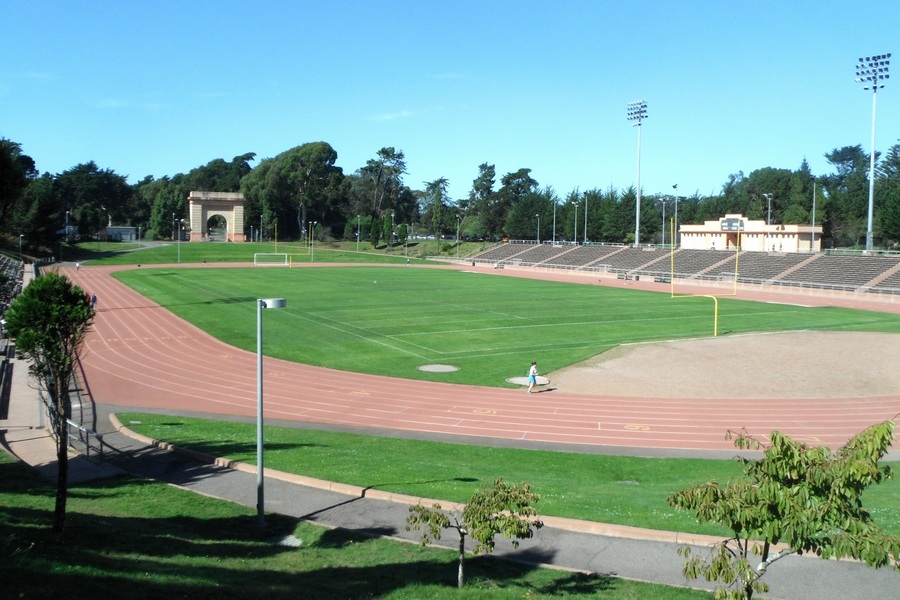

More than a game, it's a recruiting trip for the coaches, a travel experience for the players, an opportunity for engagement with the alumni, and the kind of media attention you'll never see around the fringe of the MSF.
Let's not forget why Notre Dame plays games at Stanford or why Army is playing a game in San Antonio next year: a national school needs national recruiting. What better way to send a statement for California recruits than to play a game there?
OK, we now return you to Georgetown Football, 2015. "Loretto, Pennsylvania, here we come..."
Sunday, August 30, 2015
North Of The Border
Just a week to go before football season--what's a fan to do?
Well, if you're on a business trip in Canada, and it's a Friday night, it's a foregone conclusion that I was headed to 60,000 seat Commonwealth Stadium in Edmonton, Alberta for a CFL game between the Edmonton Eskimos and the Toronto Argonauts (the former team where Alex Buzbee played professionally after his one season with the Washington Redskins). And while I can say with some certainty I was the only fan wearing a cap which read "Georgetown Football", I learned a little bit more about what building a fan experience is all about.
1. First, make it convenient. Commonwealth Stadium is just two stops on the rail line from downtown--I was literally out the door of my hotel and in my seat in under 15 minutes. Better yet, the city of Edmonton declares free rail fares on the train to and from every home game. Given the lack of parking in that part of town, that's not only good business, that's good public policy.
2. Next, encourage people to tailgate...even in the stadium. Granted, the dimensions of a CFL stadium are longer and wider than an NFL or college field, but lacking any parking lot for such pre-game activities, the team has built a little corner of the end zone as a sideline club of sorts, along with four other locations for people with a little more to spend and enjoy a different game experience.
3. Involve the community. Friday night's game honored the Canadian military, and a group of soldiers and airmen brought out the Canadian flag at the national anthem, Granted, Canadians don't have the same display of nationalism as they do in the United States (or certainly not here in Texas, where we also sing the state anthem after the national one), but it was a nice show of support to the men and women in uniform.
4. Raffles. Long a staple of youth sports, the Eskimos have made it a way for one fan to win a small fortune. The premise is simple: for a $2 ticket, half supports youth football and half goes in the winner's circle. It's the "50/50" deal. By the fourth quarter, over $80,000 was up for grabs to one prizeholder. A month ago, a record $348,534 was given away. Granted, there 's some rules that work in Canada that may not work south of the border, but with that growing number on the scoreboard, it kept your attention:

And yes, that score was 10 to 1. The concept of the rouge makes as much sense to am American football fan as the infield fly rule can be properly explained to a cricket fan, but it's a staple of Canadian football scoring.
5. A family friendly experience. You won't find more courteous people than Canadian sports fans, period, Even with a pint or three, they take their manners seriously. I only heard one profanity uttered all night, from a middle aged woman who promptly covered her mouth and tried to look inconspicuous.
6. Lots of cheering. Despite it being a professional game, the Eskimos (and many CFL teams) have an atmosphere closer to a mid-tier Division I-A game rather than the NFL. Instead of the Dallas Cowboys Cheerleaders, the Edmonton Cheer team was more like a college group, with tumbling teams and signs urging the crowd to cheer back and forth. The t-shirts below were part of the "Support Our troops" campaign--in fact, two of the cheerleaders were active duty military:

Owing to the military theme that night, the halftime presentation featured the Canadian Royal Regimental Band. They opened with the 1983 pop song "99 Red Balloons", to which a passerby remarked, "Well, there's an ironic tune, isn't it?" (For the younger fans, this was probably the only Billboard Top 100 song in recorded history that sang about a nuclear missile exchange.)
7. A Fight Song. From that 10-1 score above in the third quarter, the Eskimos pulled away, not before another touch of U.S. college -style football: a fight song.
Chances are, unless it's Hail To The Redskins, you'd be hard-pressed to think of many pro football fight songs. ("Detroit Lions, Down the Field", anyone?) At the end of the third quarter, the Edmonton fans had their version of the seventh inning stretch, with 81 year old broadcaster Bryan Hall chanelling his best Harry Caray. Here's Hall in a 2008 game:
8. Easy Come, Easy Go. Final score: 38-15. Good seats, good times.

The game was over, and people went home. Even the traffic signs were altogether Canadian:

But something that does relate back to Georgetown was the fans: they wore the colors. Lots of green and gold, lots of football shirts, jackets, and caps. Moms, dads, grandkids, you name it. And plenty for sale, too. No one went home without a little more green and gold.
Yet only at Georgetown could fans be given one week, and only one week, to order football gear at an inflated price, and that's it. Try finding a copy of the new jerseys at the bookstore, or even at the game. You won't see it. Or ask yourself why a design of the jersey is on the official site that looks nothing like either the old or the new jerseys (never mind they don't even have names on the jerseys):

In the end, you build a fan base by being authentic to their support, and authentic to their team. Georgetown doesn't have to be Alabama or UCLA to have a great fan experience. Does it?
Edmonton hasn't won a CFL title in 10 years. But the fans will still be back. If the Hoyas get drummed by Marist or Dartmouth, do they even come back in October?
Georgetown could learn a little from their friends up north that, win or lose, you make the home game experience an event, and welcome them back as eagerly as you welcomed them the first time: a week ago, a season ago, or 50 years ago. That's what a football game is all about.
Well, if you're on a business trip in Canada, and it's a Friday night, it's a foregone conclusion that I was headed to 60,000 seat Commonwealth Stadium in Edmonton, Alberta for a CFL game between the Edmonton Eskimos and the Toronto Argonauts (the former team where Alex Buzbee played professionally after his one season with the Washington Redskins). And while I can say with some certainty I was the only fan wearing a cap which read "Georgetown Football", I learned a little bit more about what building a fan experience is all about.
1. First, make it convenient. Commonwealth Stadium is just two stops on the rail line from downtown--I was literally out the door of my hotel and in my seat in under 15 minutes. Better yet, the city of Edmonton declares free rail fares on the train to and from every home game. Given the lack of parking in that part of town, that's not only good business, that's good public policy.
2. Next, encourage people to tailgate...even in the stadium. Granted, the dimensions of a CFL stadium are longer and wider than an NFL or college field, but lacking any parking lot for such pre-game activities, the team has built a little corner of the end zone as a sideline club of sorts, along with four other locations for people with a little more to spend and enjoy a different game experience.
3. Involve the community. Friday night's game honored the Canadian military, and a group of soldiers and airmen brought out the Canadian flag at the national anthem, Granted, Canadians don't have the same display of nationalism as they do in the United States (or certainly not here in Texas, where we also sing the state anthem after the national one), but it was a nice show of support to the men and women in uniform.
4. Raffles. Long a staple of youth sports, the Eskimos have made it a way for one fan to win a small fortune. The premise is simple: for a $2 ticket, half supports youth football and half goes in the winner's circle. It's the "50/50" deal. By the fourth quarter, over $80,000 was up for grabs to one prizeholder. A month ago, a record $348,534 was given away. Granted, there 's some rules that work in Canada that may not work south of the border, but with that growing number on the scoreboard, it kept your attention:

And yes, that score was 10 to 1. The concept of the rouge makes as much sense to am American football fan as the infield fly rule can be properly explained to a cricket fan, but it's a staple of Canadian football scoring.
5. A family friendly experience. You won't find more courteous people than Canadian sports fans, period, Even with a pint or three, they take their manners seriously. I only heard one profanity uttered all night, from a middle aged woman who promptly covered her mouth and tried to look inconspicuous.
6. Lots of cheering. Despite it being a professional game, the Eskimos (and many CFL teams) have an atmosphere closer to a mid-tier Division I-A game rather than the NFL. Instead of the Dallas Cowboys Cheerleaders, the Edmonton Cheer team was more like a college group, with tumbling teams and signs urging the crowd to cheer back and forth. The t-shirts below were part of the "Support Our troops" campaign--in fact, two of the cheerleaders were active duty military:


Owing to the military theme that night, the halftime presentation featured the Canadian Royal Regimental Band. They opened with the 1983 pop song "99 Red Balloons", to which a passerby remarked, "Well, there's an ironic tune, isn't it?" (For the younger fans, this was probably the only Billboard Top 100 song in recorded history that sang about a nuclear missile exchange.)
7. A Fight Song. From that 10-1 score above in the third quarter, the Eskimos pulled away, not before another touch of U.S. college -style football: a fight song.
Chances are, unless it's Hail To The Redskins, you'd be hard-pressed to think of many pro football fight songs. ("Detroit Lions, Down the Field", anyone?) At the end of the third quarter, the Edmonton fans had their version of the seventh inning stretch, with 81 year old broadcaster Bryan Hall chanelling his best Harry Caray. Here's Hall in a 2008 game:
8. Easy Come, Easy Go. Final score: 38-15. Good seats, good times.

The game was over, and people went home. Even the traffic signs were altogether Canadian:

But something that does relate back to Georgetown was the fans: they wore the colors. Lots of green and gold, lots of football shirts, jackets, and caps. Moms, dads, grandkids, you name it. And plenty for sale, too. No one went home without a little more green and gold.
Yet only at Georgetown could fans be given one week, and only one week, to order football gear at an inflated price, and that's it. Try finding a copy of the new jerseys at the bookstore, or even at the game. You won't see it. Or ask yourself why a design of the jersey is on the official site that looks nothing like either the old or the new jerseys (never mind they don't even have names on the jerseys):

In the end, you build a fan base by being authentic to their support, and authentic to their team. Georgetown doesn't have to be Alabama or UCLA to have a great fan experience. Does it?
Edmonton hasn't won a CFL title in 10 years. But the fans will still be back. If the Hoyas get drummed by Marist or Dartmouth, do they even come back in October?
Georgetown could learn a little from their friends up north that, win or lose, you make the home game experience an event, and welcome them back as eagerly as you welcomed them the first time: a week ago, a season ago, or 50 years ago. That's what a football game is all about.
"We're fighting on 'til every game is won
The green and gold is bold and when we're done
We'll tell the world we’re proud of Edmonton
And the Edmonton Eskimos."
Tuesday, August 25, 2015
Jersey Boys
In a quiet off-season for the 2015 Georgetown Hoyas, the team got its most coverage by, of all things, a jersey change.
But that was only half the story.
Such changes seem to rotate every two years on the Hilltop, nothing like the run of Oregon's uniforms du jour or even the regular rotation of basketball jerseys seen at the University. One hoop jersey appeared for the regular season finale, saw action in five games, and already seems to be gone for good. You can do that with 15 jerseys, not 100.
I guess the fan base can be thankful that Nike didn't put something really silly out there, but the look of the 2015 Hoyas isn't anything to write home about. In fact, it looks a lot like the style of the Michael Ononibaku era, circa 2005:

Were they playing to this era? Of course not. Nike doesn't invest in Georgetown's jerseys as they do for basketball, so it's more likely they offered three of four generic designs and the staff decided on a simple one. And it's simple--no "wow" factor, unless you count the words "Hoya Saxa" along the sides of the pants. It certainly could have been worse.
As for an alternate helmet, well, what were they thinking?
Georgetown has worn gray or silver-shelled helmets for 50 seasons, and it served them well. Who thought of picking up the Georgia Southern helmets instead?

The style of numbers only and color (a near-black, at least from the photos) bear no particular ties to Georgetown. A post on a Lafayette message board suggested it was a nod to its pre-1950 heritage (when Georgetown wore blue helmets), but that's a stretch even to this amateur historian. I'm not convinced alternate helmets are necessary, but a simple switch to a gray G on a blue helmet would have been even more impactful.
Uniform styles don't change on great programs: Alabama, Penn State, Georgia, USC. Georgetown had a great look in the Sgarlata-as-player era and it would look great today:

But that's not Nike talking.
So what's that on top of the helmet?

If it's Nike, that means a generous dollop of kente cloth design, something I've complained about for nearly 20 years. I still get questions as to what my problem with it is, and it gets a little complicated. Here, once and (maybe) for all, is my argument:
As of late August, they haven't been seen in a single photograph, tweet, or Facebook post. It's likely that Georgetown didn't get a pair of road unis from Nike, and will likely be using the 2013-14 style which bears no resemblance to the new look:

This, of course happened two years ago, as the white jerseys were new and the blue jerseys were two years older, as if GU can't get a pair of jerseys anymore. And unless you're the Dallas Cowboys, home and away jerseys should be the same style.
Clothes maketh the man, but not in football. It's what's inside that counts, even with that Georgia Southern helmet.
(And for a further look into jerseys, check the Georgetown Football History Project.)
But that was only half the story.
Such changes seem to rotate every two years on the Hilltop, nothing like the run of Oregon's uniforms du jour or even the regular rotation of basketball jerseys seen at the University. One hoop jersey appeared for the regular season finale, saw action in five games, and already seems to be gone for good. You can do that with 15 jerseys, not 100.
I guess the fan base can be thankful that Nike didn't put something really silly out there, but the look of the 2015 Hoyas isn't anything to write home about. In fact, it looks a lot like the style of the Michael Ononibaku era, circa 2005:

Were they playing to this era? Of course not. Nike doesn't invest in Georgetown's jerseys as they do for basketball, so it's more likely they offered three of four generic designs and the staff decided on a simple one. And it's simple--no "wow" factor, unless you count the words "Hoya Saxa" along the sides of the pants. It certainly could have been worse.
As for an alternate helmet, well, what were they thinking?
Georgetown has worn gray or silver-shelled helmets for 50 seasons, and it served them well. Who thought of picking up the Georgia Southern helmets instead?

The style of numbers only and color (a near-black, at least from the photos) bear no particular ties to Georgetown. A post on a Lafayette message board suggested it was a nod to its pre-1950 heritage (when Georgetown wore blue helmets), but that's a stretch even to this amateur historian. I'm not convinced alternate helmets are necessary, but a simple switch to a gray G on a blue helmet would have been even more impactful.
Uniform styles don't change on great programs: Alabama, Penn State, Georgia, USC. Georgetown had a great look in the Sgarlata-as-player era and it would look great today:

But that's not Nike talking.
So what's that on top of the helmet?

If it's Nike, that means a generous dollop of kente cloth design, something I've complained about for nearly 20 years. I still get questions as to what my problem with it is, and it gets a little complicated. Here, once and (maybe) for all, is my argument:
Kente cloth is a deeply held cultural symbol of the Ghanian people, specifically the Ashanti tribe. It was never made as a marketing tool; yet, by Nike's generous use of it on Georgetown basketball jerseys from 1994-97 (playing off Georgetown's popularity in the black community) it cheapened what kente is all about.
Would Nike have been so cavalier to use the stripes of the Hebrew tallit to sell warm-up jackets? How about a jersey that looks like a dalmatic? How about references to Allah on a design to sell Nike shoes? (Well, they actually did that one ...)
Kente cloth has no institutional ties to Georgetown University whatsoever and to suggest that it does is disingenuous. It's a Nike branding instrument, nothing more, which is sad. The point is that cultural artifacts are not suited to selling merchandise, and as a global university, Georgetown should have known better. Yes, the relationship Georgetown basketball has with Nike may override such thinking, but how does it tie to football? It doesn't.
Finally, I said that the new jersey design was only half the story. Where are the white (road) jerseys with the new design?
As of late August, they haven't been seen in a single photograph, tweet, or Facebook post. It's likely that Georgetown didn't get a pair of road unis from Nike, and will likely be using the 2013-14 style which bears no resemblance to the new look:

This, of course happened two years ago, as the white jerseys were new and the blue jerseys were two years older, as if GU can't get a pair of jerseys anymore. And unless you're the Dallas Cowboys, home and away jerseys should be the same style.
Clothes maketh the man, but not in football. It's what's inside that counts, even with that Georgia Southern helmet.
(And for a further look into jerseys, check the Georgetown Football History Project.)
Monday, August 24, 2015
Where Football Is Everything
For all the excitement about a new season for Georgetown football, facts are stubborn things. In the last 15 years, Georgetown fans have enjoyed just one winning season, and students have a way of smelling a struggling program at a distance. They might come to the first game, they'll show up at the tailgate at Homecoming, and then the talk will turn to basketball.
That's unfortunate in so many ways, but it speaks to a fan base that, for better or (mostly) worse, doesn't appreciate football for what it is: a great game, win or lose. That's an experience you don't get on TV or on a video feed, but for a lot of newer fans, this may be their own experience to the game these days. Unless you're a student at a Big 10 or SEC school, a ticket to one of these high-voltage games would set you back a monthly car payment, and the Patriot League pales in comparison. Add in the lack of any rivalries between Georgetown and schools in that conference, and students tune out before they even give it a chance.
As students return to college across the nation this weekend, one freshmen is ready for football. She's Cole McConachie, from Verona, NJ, who wrote a column at Odyssey Online about what football means to her.
"Football, in a lot of small towns like mine, is the heartbeat of the fall," she writes. "And although football doesn’t completely dominate my small town as I’m sure it does in some small southern towns, it’s such a big part of fall life here. Whether it’s a football game played by the local youth, the high school team, the college players, or a professional team, football is uniting. Football, more than any other sport in America, brings people together."
Another excerpt follows:
"Whether it’s the mother rooting on her son, the girlfriends decked out in their boyfriends’ jerseys, or the old man who played on this same team himself many years ago—everyone comes out for the game. The small sports store in town sells the jerseys of the high school football legends. The band gets the crowd hyped up as we cheer until we lose our voices.
"I can remember spending all day, all weekend, watching games. I’d wake up early to watch my brother play and then stay for the next game, and the next one, until the sun went down and I’d realized the only thing I had eaten all day was a pretzel from the snack bar. I even announced a couple of youth games before I realized that being a screaming fan was more my forte than holding back my cheers through the loudspeaker."
She continues. "The critics complain about the emphasis on the what some call the violent nature of the sport. They complain about the stereotypical “dumb jocks” that football players are made out to be, and although I don’t think they’re heroes like some claim, they’re for the most part good guys and together they make a family. A football team creates the type of comradery [sic] that is rare to come across because every single person is critical to every single play. Every team member has to come together each play to make the pieces work; one man can’t hold the team up alone.
"In my town, the football family extends beyond the field, from the players and coaches to the families and fans, the small businesses, and the booster clubs—football allows people of all backgrounds and walks of life to come together to support one common goal."
And the best part? Where she's headed.
"This fall will be a bit different. I will miss seeing my younger brother’s games and the fan section full of familiar faces at the high school games. But you can guarantee that I’ll be in the stands at Georgetown, at every game cheering on my new team because that’s what I know how to do best."
Memo to the Gridiron Club: get this student a t-shirt, a jersey, a front row seat at the tailgate, whatever it takes. Georgetown, and college football, needs more fans like this.
Monday, June 1, 2015
A Second Chance
"At UAB in Birmingham
All hail our players bold
They are the mighty Blazers
Who wear the green and gold..."
It's early June, but it's still a good day for football. A great one, perhaps.
You don't have to be from Birmingham, or step foot on its campus, or know the difference between Southside and Mountain Brook to raise a toast to the decision by the University of Alabama-Birmingham to reverse a decision to drop football.
Such reversals of fortune are rare in the number-crunching world of college athletics, even more unlilely in the rarified air of I-A football. No I-A school has dropped football in almost 20 years, and no school had brought back football since SMU in 1988. Politics nearly killed football, and politics brought it back.
UAB football began as a Division III independent in 1991, and when 26 other schools made the leap up to I-AA, the Blazers kept going, joining I-A by 1996. With only one bowl bid and a combined record of 106-147 in I-A, no one was confusing the Blazers with the Crimson Tide or War Eagle. But because the school is the "University of Alabama" at Birmingham, trustees from the flagship began to make their case--the only football in the Alabama system would be played in Tuscaloosa, not Birmingham.
Led by its chairman, Paul W. Bryant Jr, (son of the most famous Alabama coach of all time), many locals felt the fix was in. On Dec. 2, with a bowl bid in the balance, president Ray Watts dropped the program and two other sports. You can't beat city hall, right?
As the Birmingham News relayed on Monday, you beat city hall where it makes a difference--in the wallet. Nearly $18 million was committed from a cross-section of Birmingham that had little in common for a commuter school--students, alumni, businesses, city leaders. The Crimson Tide is everywhere in the city, but the green and gold would not go quietly.
"Look at what the supporters of a program "nobody cares about" were able to accomplish, wrote columnist Kevin Scarbinsky. "They didn't just overcome the kind of old money and secretive, selfish, self-perpetuating power that's held this entire state back forever. They brought a football program back from the dead, and they gave new life to a university and an entire city...."
"And now, against all odds, with Clark returning to lead the rebirth as head coach, that wrecking ball has a massive crack in it. UAB football, rifle and bowling have new life. There's hope for this university and this city yet."
So UAB lives again. Can it be repeated elsewhere? It's not so easy. The newspaper provided a list of five key factors for the turnaround, something not every school can engineer on such short notice:
- A former football player who became the face of the #Free UAB movement, driving a sustained fundraising campaign when the money wasn't (yet) there;
- A state representative, who felt that Tuscaloosa was calling the shots and who worked behind the scenes for financial and organizational support;
- Two local businessmen who were able to raise neatly $8 million from the Birmingham business community;
- An interim athletic director whose time on campus was going to be short if he took on the trustees, but kept ties with Conference USA and helped make the case that an exit from football would cost UAB in more ways than one; and
- An inspirational student leader who understood the power of social media and galvanized an indifferent commuter population to fight for its identity, not just a team.
The youngest football alumnus at Seton Hall is over 50. The mayor of Stockton or Santa Clara is not going to put his reputation on the line for a college team. Is there a student leader at GW who would even see the need to fight for sports on its concrete campus, or would he shrug his shoulders and worry about his resume?
As an institution, the University of Alabama-Birmingham is just 45 years old. Traditions are hard to come by when you haven't been around that long, and even more challenging when larger schools within the state demand loyalty over all else. The Crimson Tide averaged 98,177 a game, the Blazers just over 21,000.
The school will regroup for football in 2016 even as most of its veterans from 2014 scattered following the announcement. The next few years will be decidedly uphill. UAB plays in a decaying Legion Field, built in 1924 and destined for implosion within the next decade. But amidst it all, UAB football will see another day.
Would that Pirates and Tigers and Broncos and Colonials could say the same.
And this being a Georgetown column, some thoughts: could the revival of UAB football have happened at the Hilltop in 1951? What would Hoya Football be like if it had never left the major college ranks?
Well, of course, it couldn't have happened, and wouldn't have, because the world of Georgetown 1951 is not the world of Birmingham in 2015.
Ray Watts is a political appointment, a university president who answers to trustees confirmed by the state legislature and answerable to the governor. Hunter Guthrie, the "president-rector" of Georgetown circa 1951, acted unilaterally to drop football. The board of directors at Georgetown was comprised solely of members of the Georgetown Jesuit community, none of whom would dare question the decision of the rector. And none did.
The mayor of Birmingham is a UAB grad who knows what a Saturday afternoon in Legion Field could do for his economy. In 1951, DC had no mayor, no elected officials. A three man board ran the capital, and the agenda was set by Congress. Sports meant little in the capital city.
Jimmy Filler and Don Hire raised $17.5 million in less than six months for UAB football. In 1951, Georgetown had no sustained fundraising organization and was some $400,000 short of finishing a gymnasium project in the works for nearly 14 years. A sustained annual fund, driven by alumni and not the school, was still three years away.
Shannon Ealy kept the UAB athletic department aligned when it could have spun out of control and provied a public sign than UAB could support football again. At Georgetown, Guthrie would have fired athletic director Jack Hagerty on the spot if Hagerty had so much whispered about promoting a return to football.
In UAB, the school has found a leader in Timothy Alexander, who will never play football again following a car crash that paralyzed him from the waist down, but whose passion for the game inspired a campus.
In 1951, any student that publicly questioned Rev. Guthrie would find a swift kick out the Healy Gates, never to return. But this is not 1951.
And thankfully for UAB, it's not 2014 anymore.
"Tonight let's fire their golden blaze
The flame of victory
Go, Blazers! Go, Blazers!
Win for UAB!"
Win for UAB!
Subscribe to:
Posts (Atom)