Tuesday, October 3, 2017

Week 4 Thoughts

Some thoughts following Harvard's 41-2 win over Georgetown Saturday.

1. Strength In Numbers: What did we learn from Saturday's game? Putting aside the obvious about a Georgetown offense that was noncompetitive, it is this: making a game an event brings out people. Lots of them.


Putting aside the pleasantries about Cooper Field having good sightlines and a engaging campus atmosphere, after 11 year of temporary seats and withering gravel, it does nothing to engender attendance to college football. That a school of over 6,000 undergraduates, nearly as many grad students, with an alumni population of over 40,000 within an hour of the school, in a metro area of more than five million cannot fill a 2,000 seat erector set is not only an indictment of the schedule, but the surroundings. It is not a destination, and all the promises about something better remain that.

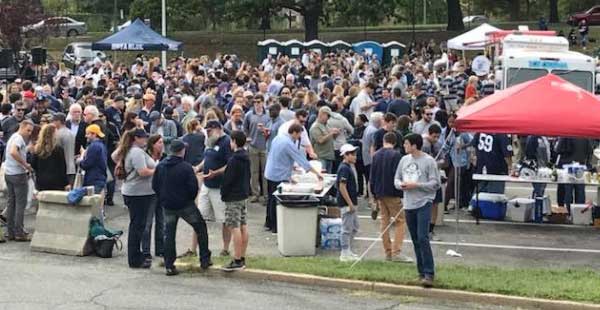
No one will confuse RFK Stadium with the Rose Bowl, but there was a sense of an event, at least before the game. That so many students put aside a few hours on a Saturday to stand in a parking lot in Southeast DC and get ready for a football game instead of worrying about what dressing goes on their sabzi salad at Sweetgreen says there is hope for this program after all, if they can schedule marketable opponents, and if they can win. Both are not imminent.

There is work to do in the community, however. While traveling on the Metro to the game, a couple interrupted and asked if I was going to the game. They were tourists from Toronto who had never seen a football game in person and were intrigued. The Blue line car emptied out after Eastern Market and the couple asked why. Someone added that there are a lot of restaurants there. The couple politely got of at Potomac Avenue for a trip back to Eastern Market, and told me they might stop by the game after lunch. Whether they did, I cannot say, but there were people out there that Georgetown couldn't close the deal on. This time.

All in all, it was a great event and I which more could have joined us. How many joined us? Well...

2. Truth In Numbers: Coming home on the plane Saturday night, I had only a wild guess at the attendance. Seven thousand? Nine thousand? Sold tickets over 10 and a walk up crowd less than that? I didn't know. I was baffled by the number placed in the official box score: 3,256, which is less than  some games at Cooper Field. It was embarrassing to Georgetown and, as far as I could determine, incorrect.

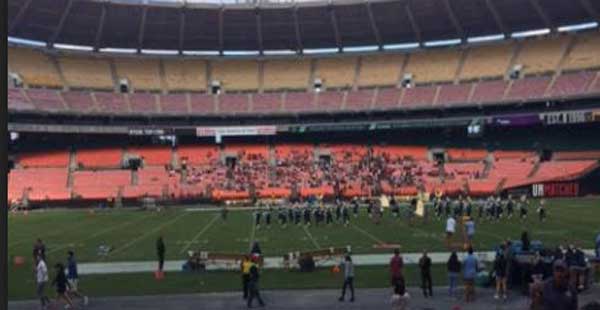
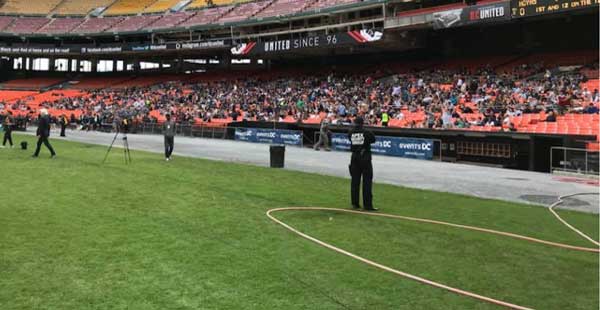
The photos on the front page showed many more people that that. If Harvard brought, say, 1,500 people (a low turnout given the strength of the Harvard alumni network in DC, but an estimate nevertheless), that about the same must be in the home stands, right? The photos don't support this.

Harvard:


And Georgetown:


Clearly the number came from somewhere, but I don't know. It has already led to a post on an Ivy League board that suggests Georgetown lost $500,000 on the game, which sounds false on many, many levels. But the official number did not serve Georgetown well nor that of the DC Events promoters, who were hoping for something to justify opening the gates of the aging structure.

3. The Next Time: Could Georgetown do this again? Yes. Should they? Absolutely.

But who, when, and where?

Upcoming schedules are less than favorable with marquee opponents. Patriot League opponents do not have the critical mass to justify any stadium rental, and, as Saturday's visitor turnout may have confirmed, neither is the Ivy League. Howard came to mind in one pre-game conversation I had, but it was quickly dismissed by someone wiser than me, and for good reason--Howard looks at a football game with Georgetown the way Georgetown looks at a basketball game with American--it's not worth their time. Where Howard fans show up in numbers to their close-knit Homecoming game, they fail to draw any interest in other events, particularly non-HBCU's.

Remember the Howard-Georgetown series, the so-called Mayor's Cup? The Oct. 15, 2011 game at Greene Stadium drew just 1,891. At the 2009 game at Georgetown, Howard didn't even bother to send the band. The attendance was less than what Harvard "officially" drew Saturday, just 2,630.

What team would draw students, alumni, and local residents to come back for a game and conversely, who would want to play Georgetown and bring heir fans to do so?  Well, Syracuse isn't walking through that door, and neither are the 90% of Division I-A schools who know there's more money in a guarantee game at Florida State or Purdue than taking your chances against a little-known I-AA team. So, here are three I'll toss out there:

Door #1: Villanova. Name recognition? Check. Interest in both student bodies? Check. Would their fans turn out? Probably, though not guaranteed. A competitive game? Not even close right now.

Villanova has a love-hate relationship with the PL, in that they love to get an easy win or two versus these teams but hate the association that they would be better off in that cohort than competing at a higher level in the CAA. Since 2005, the Wildcats have played every PL school except one, and that's no accident. For years, Andy Talley wanted no association with the comparatively low-rent program that also happened to play in the Big East.  Would new coach Mark Ferrante think differently?

Villanova has only three non-conference games annually because of the composition of the CAA: one with temple, one other I-A, and a PL team, often Lehigh or Lafayette. Could a bigger game in DC get their attention? Not right now.

Door #2: Delaware: An even more dangerous opponent than the Wildcats, the  Blue Hens have no particular history with Georgetown (the teams haven't met in basketball since 1966) but they do have a fan base that will travel. The Blue Hens sent nearly 10,000 to Frisco, TX for the national championship game with Eastern Washington, and average about 16,000 a game in Newark, DE, down from the days when a sellout of its 22,000 seat stadium was a certainty. Two hours from the District, they would travel.

Delaware's non-conference schedule used to be fearsome. Not so this year, a peculiar collection that includes Delaware State from the MEAC, Virginia tech, and Cornell. The Blue Hens defeated Cornell, a team not much different than GU this year, 41-14. Delaware has upcoming games with Pitt and NC State, do they need a breather?

Door #3: Army. A nationally known team with a built-in fan base, Army isn't afraid to schedule PL opponents (even if they stumble from time to time) and can also whoop up on them too: the Cadets mauled Fordham, 64-6, a year after losing to them. Among I-A teams, the academies are most likely to be PL opponents and, as opposed to Navy (who has no need to play in Washington when Annapolis is 30 miles east), might consider a game in the National Capital Region to play in front of their commanding officers.

Army's future schedules go out to 2030 and not all dates work for their opponents. As an independent, however, they need games. The 2019 season, for example, features the likes of Morgan State, with Bucknell in 2020 and 2021. Absent a team dropping a game, the Hoyas may be late to this discussion.

As for where, that's a discussion. DC United has one game remaining in the building, an Oct. 22 game titled "Last Call". After that, the future of RFK gets tenuous--the stadium stayed afloat with soccer after the Redskins left, and they fact that is was still standing helped bring the Nats from Montreal. After soccer leaves, there are literally no scheduled events there. Even the Military Bowl, one of those generic pre-New Year's bowl games that serve as ESPN programming and little else, moved out in 2013.

Some in DC envision the stadium site as the ultimate lure to bring the Redskins back to town, with a domed stadium that would host Final Fours, political conventions and college football classics far removed from the Patriot League. Others can't get around a name they otherwise embraced for so many years.

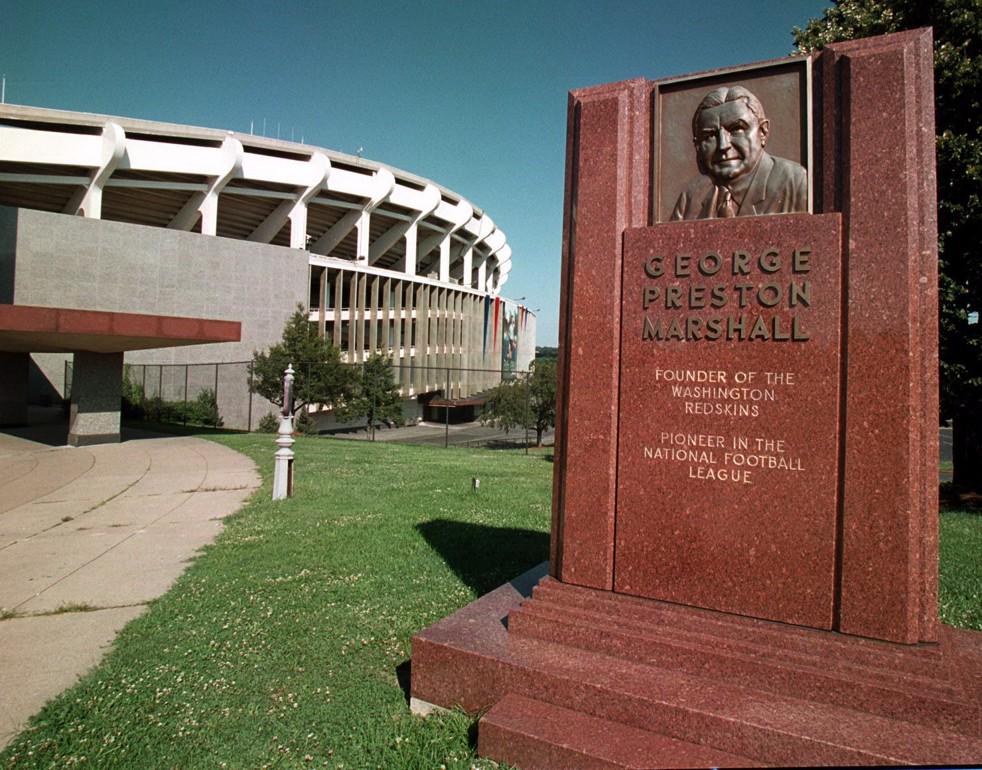
(An aside: At the entrance to RFK Stadium is seen a monument to George Preston Marshall,  the founder of the Skins. A unrepentant bigot whose fight song read "Braves on the warpath, Fight for all Dixie"), Marshall was once quoted as saying that We’ll start signing Negroes when the Harlem Globetrotters start signing whites." In 1962, the Kennedy Administration threatened to revoke his lease to then-DC Stadium to force Marshall to integrate the team. A resident of Georgetown, Marshall died in 1969.)


Others see the future of  RFK Stadium as some sort of recreational parkland or even some big-box urban village. Whatever the outcome, the old building's days are numbered. Maybe the Hoyas will return, maybe not.

Down by Nationals Park, however, construction is underway on this place:


If Georgetown wants to revisit this in, say, a couple of years, make a call to Audi Field, which is to include, in no particular order, 31 luxury suites, 500,000 square feet of mixed use residential and commercial space, and parking for 447 bicycles for the sustainability-sensible crowd. An aging RFK might have been too much for the upscale Washingtonians out there, but this will fit right in.


To sum up:

Who? No good candidates right now.

When? Not clear.

Where? Old or new, take your pick.

And finally, why? Because Saturday's game showed that,done right, it's a win-win for Georgetown football, even if the outcome wasn't.


Thursday, September 28, 2017

An Invitation

You don't have to be a Google researcher to know why people visit HoyaSaxa.com. It's all about the basketball. 

Twenty one years ago this weekend, this site was launched. Victor Page was a 21 year old sophomore, home basketball games were a bus ride to Landover, and America Online boasted of seven million subscribers who could visit any one of 200,000 web sites across the world, including this one.  

Did you join us?

Then and now, the Big Brother of Georgetown Athletics was, and is, why we're still coming here. So, for once, let me introduce you to Georgetown Basketball's older brother, who's got a big weekend of its own planned.

Excusing a statistical handful of elderly readers, none of us have a memory where Georgetown football was a destination event, when the Hoyas played the likes of Penn State, Miami, or West Virginia, not to mention Syracuse, Villanova, or Boston College.  Ole Miss came to town and drew 25,000, while the Hoyas went to Yankee Stadium and doubled that figure. But when Georgetown short-sightedly cut football in 1950, a little bit of the Georgetown ethos and culture was severed with it, something which no sidewalk at McDonough or parking lot in Landover or even a underground parking garage in Penn Quarter has fully healed.

Basketball is a winter sport--you arrive, you watch, and you leave. Socializing is done in a concourse, or on the way to a bar to get out of the elements. Our basketball traditions are tucked high into a corner of a darkened arena, and that's what we've come to expect. By contrast, football thrives in its social interaction, something altogether lacking at  school which largely ignores its on-campus teams. Why else do 60,000 people at Stanford or 80,000 at Notre Dame or 100,000 at Alabama come out ever weekend? It's not to watch a game that's much more comfortable in front of a high definition TV set. It's not for a love of traffic jams or walking up huge flights of stairs. "From the moment you enter the parking lot to set up camp and tailgate for the day, donning your favorite team's gear, to the packed and raucous environment in the stadium," wrote Bleacher Report. "If you're watching college football, the experience is the same everywhere you go: electric."

This writer apparently has never been to Georgetown.

Couple that with the low wattage nature of Georgetown football, so low that a Heisman Trophy winner last weekend hadn't even heard of it, such spirit has been, in many respects, a lost opportunity. The poor fan experience around the never-built on-campus stadium and the litany of tired, uninspired excuses from the University about promises never kept have always cast a cloud about a sport that predates basketball by a quarter century and once was every bit the unifying force basketball has become today.

This Saturday, against the relentless typecasting that Georgetown football is decidedly a small time effort, the Hoyas will host a game at a legitimate big time venue, RFK Stadium, home of the Squire and the Hogs and thirty years of NFL glory. Yes, the place has seen better days and may not see many more if the price of land grows unabated, but for one Saturday in September, before sunny skies and 66 degrees, the Blue and Gray host the Crimson lines of Harvard. 

Okay, not exactly Ole Miss, but an opportunity nonetheless.

Almost twenty years ago former football coach Bob Benson wrote that " There must be a vision" for football. "It is really quite simple," he said. "Utilize the game of football to create an environment and atmosphere among our students, faculty, and community on an autumn Saturday afternoon and bring to our campus a school spirit on a fall day that is desperately needed." Saturday's game, on a big stage and a reasonably big opponent, offers just that sort of spirit and camaraderie, if we only choose to join in. There will be activities for families, for college students, for parents, and for older fans, too. Food trucks, marching bands, and tailgating will, for a few fleeting hours, reintroduce Georgetown to the verities of a Saturday football experience it dispatched so many years ago. You don't have to be a huge football fan to enjoy the experience, but you do have to be a part of it.

Can you join us?

The numbers are small for those of us who build their schedules around Gerogetown football, much less argue the finer points of Hoya gridiron history. Outside of Rob Sgarlata and Bruce Simmons, not many of us can argue on a Saturday afternoon tailgate whether Aley Demarest or J.J. Mont was the better quarterback, whatever happened to Alondzo Turner, or simply what it was like to watch the Hoyas on ESPN2 on a Friday night and win a game on a last second field goal.

But this isn't a history lesson. Saturday is a chance to make new history, meet some new friends, and perhaps realize something I've tried unsuccessfully to point out all these years--athletics isn't a zero sum game. You can be a Georgetown basketball and a Georgetown football fan and have fun doing both. Basketball's time will come.

A game on a big stage is a financial risk, and under any circumstances there are going to be a lot of empty seats in a stadium which has held up to 56,692 people. 

But your seats don't have to be empty. If you live in the area, a $12 ticket and a ride on the Metro is a low cost way to enjoy a unique Georgetown event and to do so on a beautiful Saturday afternoon. And while there are no guarantees whether 1,500 people will show up or 15,000, this is an opportunity for Georgetown to come together in ways that its half-fast, on-campus experience has never quite done.

Will you join us?

"Football is America's game," wrote columnist Luke McConnell in 2010. "Sure baseball was once, but that is now America's pastime. Football is now. Nowhere else in the world is football regarded as a sport worth following or getting excited about. But here in America, it's everything." 

"What is there not to love about football? The action is fantastic, the joys of victory incredible, and the relationships you build with fellow fans and opponents are unlike any other relationship you could ever form."

Sure, Georgetown won't be rolling out a 300 person marching band to form the Block G, there won't be an Air Force flyover, and the RFK stands won't dangerously sway as they did when the cheers "We want Dallas!" filled the air over East Capitol Street. In 2017, it doesn't have to be "big time" to be a "good time." After years of institutional inertia over football at Georgetown, here's a chance to play a game and enjoy doing so.

I will not go as far as former college coach T.A.D. Jones, who famously told his team, "Gentlemen, you are about to play football against Harvard. Never again may you do something so important." Yes, it's a big game, and while Jones' Yale team shut out Harvard 13-0 that day, that isn't happening Saturday. 

But I will say to this team, the coaches, and to its fans, this is an opportunity ripe for greatness. Win or lose, make Saturday a day we can all talk about with pride and good feeling, for generations to come.

Join us. Straight for a touchdown.


Tuesday, September 26, 2017

Week 3 Thoughts

Some thoughts following Columbia's 35-14 win over Georgetown Saturday:

1. Uh-Oh, Not Again: It was fifty-one weeks ago that a late hit on the Georgetown sidelines spelled the end of Tim Barnes' season, and the beginning of the end for the Hoyas. fast forward to last weekend, and another injury to Barnes took the air out of the Hoyas' sails.

Georgetown didn't win another game after Barnes' injury in 2016, and only one since. Is another extended losing streak on the horizon?

That depends, of course, if Barnes can play, and if GU has said something, you didn't read it in the local press. Much like last season, Clay Norris didn't show much, but that may be more a knock at the Hoyas' tentative offensive game plan from OC Mike Neuberger than anything else.  Neuberger's calls in the Marist game channeled the days of Jim Miceli, who famously had first and goal at the Howard two yard line in 2009 and ran the ball four times up the middle for, you guessed it, no yards in four attempts. In this most recent game, Neuberger's plays merited two yards in 22 carries. Such is not the calculus to defeat Harvard, the Crimson having outscored the Hoyas 110-20 in its last three meetings.

More to the point, Georgetown has scored just three points by halftime in three games this season, to arguably three of the weaker I-AA teams nationwide.  This isn't three points to Cal Poly, Richmond and Buffalo (the first three opponents for Colgate), or three points against Army, Central Connecticut and Eastern Washington (the first three opponents for Fordham), or even Connecticut, New Hampshire and Dartmouth (the first three non-conference opponents for Holy Cross. No, this was Campbell, Marist and Columbia.

So, the stats by team as to points scored this year after two quarters:

Lehigh, 82
Holy Cross, 63
Bucknell, 61
Fordham, 54
Colgate, 34
Lafayette, 20
Georgetown, 3

That's beyond unacceptable--if that's the best this offense can do, find 11 more kids down the roster and give them a shot.

2. As The Offense Goes, So Go The Hoyas. Two sobering statistics:

1. In its last 10 games, Georgetown has averaged 11 points per game and has lost nine of ten.

2. When giving up more than 14 points in a game, not an unreasonable number, Georgetown has lost nine straight, 13 of its last 14, and 39 of its last 44 over the last five years.

Georgetown may not beat Harvard, but it certainly can't beat Harvard with the offensive approach has been putting on the field of late.

3. Whither the Patriot League? Georgetown's not the only PL club with some questions. The league as a whole is a combined 6-19 in non-conference play, with no team over .500 and perennial titleists Lehigh and Colgate sporting a combined record of 1-7.

What's going on?

As noted above, the PL schools are generally playing tougher opponents as scholarships make them more attractive--outside of Georgetown and Bucknell, schools like Marist aren't on PL schedules anymore. Granted, there are outliers--Lehigh has already allowed 205 points this season compared to just 323 all last season, but the PL teams will be well prepared for conference play, a further call to action to get its offense in gear over the next two weeks.

4. In Case You Missed It: ESPN College Gameday had the Hoyas front and center last week, a first for this team. Check it out beginning at the 5:54 mark of the video:


Thursday, September 21, 2017

Week 2 Thoughts

Some thoughts following Marist's 14-12 win over Georgetown Saturday:

1. A Bad Loss. No sugarcoating necessary, this was a bad loss to one of few winnable opponents on the 2017 schedule. Where Georgetown was able to compensate for a weak offensive showing by Campbell with a strong defensive showing and a pair of critical turnovers, the Hoyas could do neither with Marist.

Giving credit where due: Marist is a good defensive team, but this is the Pioneer League and Georgetown should have better offensive weaponry than it does. But it does not.  Despite a senior-heavy lineup, Georgetown is a slow, reactive offense whose play calling in recent years is predictable and often under performing. It's why teams like Harvard and Fordham seemed to key off the Hoyas in early game series last year.

Georgetown has scored just three points in the first half over two games this season, which is a big red flag given the caliber of competition. It was 12 points at the half in 2015 and just over 10 in 2016--that's putting the defense in a position of weakness all day.  Granted, this is not new.

From 2001 to 2016, the Hoyas have placed just two selections to the first team all-Patriot league team, but Luke McArdle was a MAAC era recruit and Jeremy Moore was a return specialist.  Put another way, not a single back, lineman, or receiver recruited since 2000 has made a list that Colgate, Fordham, and Lehigh have a combined 141 selections during that same period.

Either Georgetown has to recruit better or play better to avoid the kind of slide it faced last season (dropping its last eight) or what may befall them beginning Saturday against Columbia. The Lions collapsed in the second half of a game last year at Cooper Field that they should have won, but it was the last win for the Hoyas. This is a markedly better Lion team this year and year three of the Al Bagnoli era at Morningside Heights  is set to produce results.

Even if we concede Georgetown  is not going to win seven or eight games this season, and we do, the offense has to put the team in position to contend. It wasn't there against Campbell and it sure wasn't there against Marist, even with last minute hopes. Georgetown needs a much better game plan, and much better execution in the next three weeks to keep the 2017 season from sliding off the page altogether. History doesn't suggest this (GU is 6-30-1 all time vs. Ivy schools) but that's why they play the game.

Bottom line: this is not the same Columbia team of the past two seasons. Is this the same Georgetown offense?


2. The Little Things. Coaches dread film sessions like this, because one or two plays may have made the difference. OK, I'll discuss three:

--Brad Hurst's blocked PAT. Never underestimate the power of special teams. The Georgetown game plan changed from 14-7 to 14-6, and whereas the Hoyas might have been able to tie the score and drive for the game winning points at the end of the game, they were playing from behind all afternoon thereafter.
--Third and 1 at the Marist 49:  With 2:53 to play, a stop here leaves the Hoyas one time out and roughly two minutes to drive down the field. Failing on this stop eats up the remaining timeout and nearly two minutes of the clock.  The net difference was a mere two yards for the remainder of the series, but the loss of time proved fatal.
--The final drive: With 15 seconds to go, no timeouts, and the clock stopped, Georgetown needed a big play to make a difference. Instead, a three yard dump-off set up the Hoyas to clock the next down and have one chance for the end zone.

3. The Only Game In Town. Unlikely as it may sound, ESPN College Gameday is broadcasting this week from New York

That's received a lot of grief from the chattering class, given that such events seem best suited to places like Tuscaloosa or State College or Chapel Hill. ESPN hasn't exactly said why this is the case (it may be a cost cutting move even with the costs of Times Square)  but in any event, they won't be in front of a stadium this week. In fact, there is only one football game in the city that day.

Georgetown at Columbia.

So, no, ESPN is not going to bring out headgear for Lee Corso to pick the winner of the game, although Jack the Bulldog would look great on him as opposed to, say, Roar-ee the Lion. But it would offer an opportunity, however brief, for the sports information folks at both schools to get in a reference (or two) that these two schools are playing this week amidst all the other talk of a three hour show.


In short, give them something to talk about. And about that headgear....


Sunday, September 10, 2017

Week 1 Thoughts

Some thoughts following Georgetown's 16-10 win at Campbell to open the 2017 season:

1. More Of the Same (Part 1): Year four of the Michael Neuberger offense was underway Saturday and, well, it wasn't much that we haven't seen before.

That's not a knock on the coach but what he has to work with. Georgetown has historically struggled to recruit impact players on offense and its offensive output over the years reflects it. The Hoyas were 115th of 123 schools on the ground last season and we saw more of that Saturday. Maybe the Hoyas can attribute just eight first downs as a byproduct of one facing of the better I-AA defenses from 2016, last season, but Campbell had losses on the defensive line and Georgetown didn't get much through the trenches.

Absent a 33 yard run by Alex Valles, Georgetown combined for 26 rushes and just 71 yards. Valles doesn't have the speed to carry this team on rushing into the heat of the PL schedule, which is why it's important to see Jay Tolliver and perhaps Jackson Saffold to get some early carries this season. Georgetown won't win many games relying solely on the passing attack. And with marist holding its first two opponents to an average of 62 rushing yards per game, Saturday's game will be an interesting test to see what faith Georgetown holds in its rushing game, or lack thereof.

2. More Of the Same (Part 2): Another solid defensive effort from the Hoyas was the difference in this game. The defensive play, especially in the fourth quarter, not only earned a win, but built the confidence of a veteran team which will need every bit of this kind of effort.

"There wasn’t a rhythm to what we were doing and you have to credit Georgetown’s defense,” said Campbell coach Mike Minter.

With seven sacks up front and forcing three turnovers in the red zone, there was a lot to like about where the Hoyas were in this game. Marist had only one red zone penetration against Bucknell versus seven against Stetson in last weekend's game, and Marist's 337 yard passing effort against Stetson will be a point of effort in this week's defensive planning. The good thing is that Georgetown has the defensive mettle to meet the challenge.

3. A View From The Creek: I had planned to attend this game but reshuffled my air plans to make the September 30 game with Harvard (Promotion? Anyone??). The good news was the excellent broadcast on the Big South Network with Campbell's radio team.

Campbell clearly seems like a program on the way up. From a crowd of nearly 6,000 for an early season game to a healthy marching band with a neat nickname ("The Sound Of the Sandhills"), Campbell seems well prepared for its move to the Big South next year. The game announcers reported Campbell was scheduled to return this game in Washington in 2018, but new conference schedules and better offers can change plans. It's likely this will be a much better Campbell team in 2018 and much like Monmouth and Stony Brook before them, the program may soon outgrow a series like Georgetown.

The Campbell announcers had a pair of "oops" moments in the game, however. They referred to the first season of Hoya football as 1895 (?), then corrected that at halftime, only to note that GU had the smallest stadium in Division I "with 1600 students".  They did note that "renovations are coming on [Georgetown's]  field", but we've heard that before...

4. Home Opener: Saturday's game with Marist hasn't drawn well in the past. Let's make a better effort to support this team and get a good turnout. This will be the Hoyas' only on-campus game until October 21, so make plans to attend.


Tuesday, August 1, 2017

A Story Worth Telling

So yes, the blog's been on an extended vacation. Not for distance, but for content.

After a while, there are just so many ways once can positively discuss a team in the midst of a eight game losing streak, and there are times where following the Hoyas is positively Sisyphean. Good news is often hard to come by, and there are only so many ways to say "better luck next year." when there is little to expect.

So in a day where not one, but two Georgetown press releases made it outside 37th and O (and you can read about basketball's retreat on another site), news that the football team will be playing "beyond the gates" for the first time since the Truman administration is a source for some old-fashioned enthusiasm.

On September 30, Georgetown hosts Harvard in the last game of that series at RFK Stadium. Not Cooper Field or Greene Stadium at Howard or even War Memorial Stadium in Arlington, but RFK, home of Jurgensen and Kilmer, the Smurfs and the
Hogs. You can still hear echoes of Tony Kornheiser's "bandwagon" in those days  when Jack Kent Cooke entertained the city's movers and shakers and the fans responded by moving and shaking the stadium in response. RFK brought a city together.
(Dan Snyder, not so much.)

Since the Nationals moved towards the Navy Yard a decade ago, RFK has aged none too gracefully, but still hosts DC United (for one more season) and the occasional concert or college game.  It hosted the Military Bowl for five years until even the bowl game looked elsewhere (in this case, Annapolis) in 2013. The Sep. 30 game with Harvard is one day removed from the 56th anniversary of the first game ever played at was then DC Stadium, when the Redskins lost to the New York Giants on October 1, 1961 before 36,767, more than double the 14,077 that showed up the year before to see the two teams at Griffith Stadium.

The RFK site is one of the great vistas in Washington, with a line of sight to the Capitol. Some see it as the future home of a retractable roof dome to welcome back the Redskins; others, as future parkland. If RFK's future is cloudy, at least Georgetown is taking advantage of it now.

Make no mistake, this is a great move. MSF/Cooper Field, good intentions notwithstanding, is still a dump that remains frozen in some sort of administrative amber and is, frankly, a problem to attracting road opponents. Yale, Penn, and Princeton have all ended series with Georgetown, and the idea of those 800 wooden bleachers doesn't win favor from its well heeled alumni. Harvard, whose four year series ends this year, may feel the same.

But the news even made the front of Harvard's sports website, and  the Boston Globe. While no one will confuse RFK with Yankee Stadium, it sends a positive message that maybe, just maybe, Georgetown can turn this football thing around.

The elephant in the room, or in this case, in the building, is seats. Lots of them. Georgetown drew all of 2,502 when the Cantabs made their only other visit to Washington, in 2014. It's one of the smallest crowds to see the Crimson in a generation, due, we hope, to the meager surroundings and landlocked access offered by Georgetown's miniature version of the Baker Bowl. (Thankfully for GU, there is no billboard which reads "The Hoyas Use Lifebuoy")

Under no such seating restrictions, any fan of either school has free reign to get on the Metro, Uber, or just drive through the gentrified neighborhoods of Northeast and park at the stadium to see the two teams meet. But there better be more than 2,500 people there on September 30.

How do you do that from a fan base that hasn't seen a crowd show up at a Georgetown football game in 50 years? Work, work, and work the audience. Here are 10 suggestions:

1. "B.I.S." In airline lingo, that's "butts in seats". Given that Georgetown isn't getting rich  off this game, the more people regardless of price that will attend, the more "successful' the outcome. To that end, consider:
1. Offer two complimentary seats to every former football player. Give them a pass to get on the field before the game, too.
2. Offer two complimentary seats to every donor to Georgetown athletics. Whether you give to the Gridiron Club, Hoya Hoop Club, or the Rowing Association, they're part of it too.
3. Market the heck out of this at the local alumni club level. Everyone should know why 9/30 is not the 9:30 Club or the end of the quarter.
4. Reduced seats to every Catholic high school in the area. High school kids love to see a real college game and most don't get to see it.
5. Reduced or free seats to District high school students. Georgetown must not only defend the district, it must invest in it.

2. Tailgate. RFK has plenty of parking and, yes, it'll have plenty that day.  Sell parking passes and allow students and alumni to set up and get a taste of what college football is like outside the patriot/Ivy bubble.

3. Bands. OK, the Georgetown band isn't very good and hasn't been for a long time. But Harvard has a good musical outfit for the oft-derided "scramble" band and they should be invited to attend. Better yet, there are some high-wattage high school bands that would love to march on the big stage on a Saturday afternoon. bands bring atmosphere and they bring, well, B.I.S.

4. Students. Yes, students are indispensable to the college football experience but most Georgetown students quickly tied of Cooper Field's shoddy surroundings and gravitate away. This needs to be marketed as a one-time experience that students can rally to.

5. Metro. Over 200,000 people ride the Metro daily and not all care about football. But some do, or some might, with an offer or two. Maybe they get in for half price with their SmartCard or are eligible for some prizes at the game site.

6. Local coverage. It's interesting to read the coverage of the 1964 game with NYU that drew 8,000 to Kehoe Field in freezing temperatures --there was coverage in the Post and Evening Star literally every day leading up to the game. And that was no accident. Nor should Georgetown's ability to get Rob Sgarlata, David Akere, the local kids, etc., in close proximity to local TV, to the Post, to sports-talk radio, and to any other outlets so this is not something forgotten in the swirl of Redskins coverage or the latest Trump nonsense, but a real event in the District. For that matter, can someone slip in "Geogetown-Harvard at RFK Stadium" on the College Gameday picks of the week? It's OK if Lee Corso goes with the Crimson.

7.  Alumni. There are 38,000 alumni in  the Washington DC area. Don't be afraid to contact them again and again to get their attention. We may be surprised of their turnout, if only we ask.

8. Harvard Alumni. There are 20,000 Harvard alumni in  the Washington DC area. We may be surprised of their turnout, too.

9. Parents.  Players' parents and families are often unsung heroes in the ebbs and flows of the season. Let's encourage them all to attend and make it an event worth remembering.

10. Atmosphere. Where possible, let's see RFK with some blue and gray around there that Saturday. John Madden famously said a big game in football needs "bunting", like the red, white and blue on Opening day . Marist College notwithstanding, this is Opening day to a new generation of Georgetown fans and GU would be foolish to ignore the opportunity and settle for 4,189 rattling around up in a 45,000 seat stadium.

A wise man once wrote that "It's here and if we blow it, it will never come again," and it applies in 2017. This could be a test if Georgetown can support a larger venue to play opponents that either can't or won't consider Cooper Field in the future--that could be Howard at RFK, Villanova at the new Audi Field, or someone we wouldn't even think about.

Maybe it opens some eyes among other opponents who see that maybe this Georgetown team has a fan base after all. Maybe it opens some eyes among some high school recruits who see that maybe this Georgetown team has a program after all. Better yet, maybe it opens some eyes within this University who see that maybe this Georgetown team has a brighter future after all.

Tuesday, November 1, 2016

Week 8 Thoughts

Week 8 Thoughts

Some thoughts following Lafayette's 17-3 win over Georgetown:

1. The More Things Change...Yes, the column missed a couple of weeks, but frankly, there wasn't much to say that wasn't said before: the defense was superb, the special teams  promising, too many penalties, and the offense is just not there. Repeating that every week doesn't solve very much.

Yet, Saturday's loss was troubling not in its sameness but in its contrast. This was not Georgetown fighting uphill versus Harvard or Princeton, nor to a Lehigh team headed to the I-AA playoffs or even a Fordham team that will host a game at Yankee Stadium next week. This was a loss, and a convincing one at that, to a Lafayette team that had lost 17 of its past 19 games, was giving up 54 points a game over its last three weeks, and hadn't won a home game against a Patriot League opponent in two years. This was the Lafayette team that the Hoyas beat 38-7 last fall for its largest margin of victory in its 15 year PL history.

And this year? One yard rushing at halftime. One possession inside the opponent 20, made possible from special teams. A run of four consecutive second half possessions that garnered a total of six yards....all this against the worst defense, statistically speaking, in the conference.

So what gives? It is strictly the lack of scholarships?  It plays a factor, but non-scholarship football hasn't stopped Georgetown from a defense that earns respect among its opponents. And I can't lay this at the feet of three quarterbacks with little or no prior college experience. Injuries don't help, either.

yes, Georgetown was dealt a short hand on offense in 2016, but we've been saying this for far too long. Excepting the two years of Dave Patenaude as offensive coordinator (and to some future historian in the PL, the 2011 season must not have actually happened, with Georgetown at 8-3 and Fordham at 1-10), the offense at Georgetown has been a bellwether of the program.  Elliot Uzelac didn't change that momentum. Neither did Jim Miceli. Vinny Marino certainly didn't turn the ship around, and now Mike Neuberger faces a stat sheet that, at any other school, would be cause for shopping resumes:

  • Passing Yardage: 107th of 122 schools
  • Passing Efficiency: 115th of 122
  • Rushing Yardage: 115th of 122
  • Total Offense: 120th of 122
  • First Downs: 120th of 122
  • Third Down Conversions: 120th of 122
  • Yards Per Completion: 122nd of 122

Unless Georgetown is playing the two teams consistently below them on those lists, which they do not  (Robert Morris, Savannah State) they're in a position of real trouble on offense. The team has scored 20 points combined in three weeks, and hasn't scored more than 20 points in any game to teams not named Davidson. 

Do the math.

At some point Georgetown has to invest in an OC. That doesn't mean Coach Neuberger can't or shouldn't do the job, but defense and special teams can't win games on its own. Lacking scholarships, the road to a winning season is as narrow for Georgetown as for any team in Division I-AA. 

"This place should have a good football program,” Coach Sgarlata told the Georgetown Voice in 2015. "We’re excellent at everything that we do. This whole place is built on being the best you can be at what you’re doing. There’s no reason why this football program shouldn’t be the same thing.”

The offense is essential to getting there, and 120th place isn't a winning number.

2. Meet the Crusaders: Up at Holy Cross, the web site is all about promoting Holy Cross' game at Fordham in two weeks--it's a big deal playing at Yankee Stadium, sure, but it's also a reflection that there's nothing big about Georgetown that you can sell to the home towners .

The Crusaders lost its starting quarterback midway through the season and have struggled through the toughest part of the schedule, a 46-14 loss to Lehigh and a 26-8 loss last week at Lehigh. Much like Lafayette, HC fans are not happy with the performance of head coach Tom Gilmore, whose record through 13 seasons stands at 69-75. The Crusaders at 3-6, Gilmore's fourth losing season in his last five years at Mt. St. James. A loss to Georgetown (a team they beat 45-7 last season) would not go well entering the Fordham game, which is expected to be the largest turnout of HC fans outside Worcester since its I-A football days.

Despite an offensive line that averages over 300 pounds, HC has not been able to get a consistent run game, relying instead on a passing game ranked third in the PL at just under 240 yards a game. Its defense ranks only 6th but Georgetown's offense of late can do wonders for a team's statistics.

"Like us, Georgetown has had injuries at some key spots, but they have shown the ability move the ball well and play great defense,” said Holy Cross head coach Tom Gilmore at its midweek release. “We need to get back on track in practice and execute much better this week in order to earn a victory.”

Neither team can afford to finish 3-8 this season. Georgetown is trending in that direction, while a loss Saturday could lead HC in the same direction. It might be as simple as the first team to 21 points wins, which doesn't give Georgetown fans a rally cry.

3. Whatever Happened To... While reviewing Mike Neuberger's bio on GUHoyas.com, I came across this note:  "In 2012 with the Hoyas, Neuberger’s wide receivers averaged 12.11 yards per catch and accounted for seven touchdowns, while helping develop Kevin Macari into a Second Team All-Patriot League selection."

Remember Kevin Macari? A promising  recruit from New Canaan, Connecticut that didn't get a scholarship offer, he turned down a preferred walk-on at Miami to play at Georgetown.


 "I just felt comfortable [at GU]," Macari told the Connecticut Post in 2012. "It is some place I want to be for the next four years." Instead, he transferred to Delaware.

Macari's football dreams ended abruptly at Delaware. His junior year was lost to injury. As a senior, he played in two games, and did not catch a pass in either. A major in Community Leadership at UD, Macari returned home to New Canaan for a job as an assistant football coach in 2015, but did not return to the staff following a June 2016 stop for drug possession.

A college football career is fleeting, but life after football can't be ignored.