Monday, October 9, 2023

Week 6 Thoughts


 Some thoughts following Penn's 42-39 overtime win over Georgetown Saturday:

1.  A Sixty Minute Game, And Then Some:  There are more than a share of college football games to which a loss is utterly deflating or completely expected, or both. Saturday's game was neither.  Georgetown and Penn played as complete a game for sixty minutes that any coach (or fan) could have asked for. 

Yes, there were mistakes made. Opportunities were given, others were lost. Giving up a safety and two interceptions at midfield was no way to open a second half, granted. But any Georgetown fan in the stands Saturday or those following along online could not have been more impressed by a  team which scored three consecutive touchdowns over the final 18 minutes of play to put themselves in a position to win. Had the coin flip gone the other way, I think they would have.

Overtime games are rare for Georgetown, and rarer still are games where the Hoyas score as many as 36 and still lose. last we week, we noted how unusual it was for Georgetown to allow 22 or more points and still win. Well, how about this one: this is only the fourth time in school history where Georgetown scored more than 35 points and lost a game. Of the four, none were as close and none came down to the end as this one did.

Over a quarter century of following these games, Saturday's game harkens back to a 2002 game between Georgetown and Bucknell at Harbin Field.  The Hoyas trailed 17-0 at halftime, 24-7 midway in the third, and 31-20 with 8:00 remaining, yet rallied to take the lead with 19 seconds remaining in a 32-31 win.  That it took 21 years to match that kind of performance probably says something about the recent state of the Hoyas, but it is a sign for this team, and those that will follow, that it can be done.

2. Ivy Woes: With the loss, Georgetown falls to 3-3 on the 2023 season, but continues a run of futility against the Ivy League.

Since scheduling Ivy opponents in 2003, Georgetown is 7-33 (.175) versus the Ancient Eight and a fitful 1-20 (.047) versus Harvard, Yale, Princeton, Penn and Dartmouth.  Many, many reasons why, but Georgetown just hasn't been competitive, and such are not the ingredients of rivalries.

3. Empty Seats: One more thing that can be said about Saturday's opponent: it was no rivalry game, either.


A generously counted crowd of just 2,250 found its way into Franklin Field for the game, which appears to have been the second smallest home crowd for the Quakers in as least 80 years at Franklin Field., per annual statistics posted online. Yes, gone are the days when 82,000 showed up when Notre Dame played the Quakers in the pre-Ivy League days of the early 1950s, or even the 35,810 who filled the lower deck thirty years ago when Princeton came to town.

The reasons for this decades-long decline are varied numerous. Some of it is the sophistry of Penn undergrads, some of it the continuing erosion of college football among local fans who are predisposed to watch the SEC Game of the Week than sit through the elements at a Temple, Penn, or Villanova game. (For what it's worth, Temple drew a season high 18,388 Saturday at Lincoln Financial Field versus another non-rival, Texas-San Antonio.)

Maybe it's just the students; or, more appropriately, you need to start with them.  This is not a generation of college students that does anything in large groups, including attendance. They do not march for football teams or to espouse political rights, they merely watch it on their Instagram account and nod accordingly.

In a  recent Georgetown Voice article, a similar theme was echoed.

"I think the first thing is, it’s a school full of students, more so than a school full of  sports fans," said women's soccer coach Dave Nolan, "I feel that probably there’s not enough students at Georgetown who are genuinely interested in sports to begin with." 

"[For] kids today, social media is the easiest way to reach them, but it’s only the easiest way to reach them if they’re already aware of you and they’re already following you. If you have a student at Georgetown who doesn’t follow women’s soccer on Instagram or Twitter, they’re not going to be any wiser. And I sometimes feel that we forget that,” he said.

"If our students get involved, we build this culture … that’s going [to] go a long way for the experience of everyone,” said John Corwin, assistant athletic director of  athletics marketing. “One thing we can all circle back to is we’re all Hoyas, we’re all a part of this family."

But for a lot of sports, football included, it's a family that doesn't pay much attention to each other.

4. Around the PL: Holy Cross may have a legitimate challenger this season that's not from the Bronx.

Lafayette 12, Princeton 9: The Leopards made some history in a 12-9 road win before 4,059 at Princeton Stadium. Scoring a field goal, touchdown, and a final safety with 1:57 to play,  Lafayette moved to 5-1 and secured its first win over Princeton in 13 tries since the  2003 season. All-time, Princeton leads the series 45-5-3, but this was Lafayette's day, moving to 5-1 for the first time since 2009 and with a week off to meet Holy Cross on Oct. 21.

Holy Cross 55, Bucknell 27: Also approaching the bye week, the Crusaders were not challenged  on the road before a turnout of just 925 at Lewisburg. Holy Cross combined for 574 total yards, led 34-14 at the half, and coasted to the win. 

Fordham 38, Lehigh 35: The Rams narrowly averted a second consecutive upset after spotting the Engineers a 21-7 lead in the second quarter and trailed 35-24 early in the fourth quarter.  A five play , 85 yard drive by Fordham QB C.J. Montes rallied the Rams to within three, while two Lehigh punts led to eventual Fordham field goals to close out the game. The Rams go out of conference to face winless Stony Brook while Lehigh will take a 1-5 record into Saturday's game versus Georgetown, which has never won at Goodman Stadium.


Thursday, October 5, 2023

Homecoming Attendance: 4,367


Saturday's Homecoming Game drew an official attendance of 4,367, the largest in the history of Cooper Field and Georgetown's largest home crowd since 1979. 

Since its opening on September 17, 2005 as Multi-Sport Field, no home game had drawn more than 3,500, the turnout that day versus Brown with temporary bleachers across both sides of the field. Without temporary bleachers in use Saturday, some questions have been raised as to how Georgetown could accommodate over 4,000 when the stated capacity of Cooper Field is 3,750, inclusive of a 750 standing-room area behind the  north goal posts, which was unused Saturday. 

The answer may well be the nature of Homecoming itself. As various Homecoming guests wandered around campus Saturday, students and recent alumni attended some of the game, but ultimately left and others filled their seats. Thus, the attendance count exceeded those that seated throughout the game.

The turnout was the largest since 1979, when Georgetown defeated St. John's 20-14 before 4,927 atop Kehoe Field. According to The HOYA, "The response was tremendous; as an overflow crowd of almost five thousand thronged to Kehoe Field for the St. John's game. Unfortunately, the University's response to the huge turnout left a lot to be desired. Many people who arrived before kickoff found themselves waiting in line well after play had begun....Thousands of the seatless milled around at ground level, obscuring the view of those who came to watch football and turning the muddy area into a veritable quagmire," it wrote.

Saturday's game was the 12th largest on-campus crowd since 1964, surpassing other Homecoming weekend events for women's soccer (643), men's soccer (509), and volleyball (321).

Date W/L Opponent Site Att.
11/20/1965 L Fordham Kehoe Field 9,002
11/21/1964 W NYU Kehoe Field 8,004
11/2/1968 W Seton Hall Kehoe Field 7,000
11/1/1975 W Fordham Kehoe Field 7,000
11/12/1966 W NYU Kehoe Field 6,970
11/4/1978 W St. Francis GU Baseball Field 6,300
10/14/1972 W Manhattan Kehoe Field 6,000
11/5/1977 W John Carroll GU Baseball Field 5,641
10/27/1979 W St. John's Kehoe Field II 4,927
10/24/1970 W Manhattan Kehoe Field 4,500
11/6/1971 W Fordham Kehoe Field 4,500
9/30/2023 W Fordham Cooper Field 4,367

Tuesday, October 3, 2023

Week 5 Thoughts


Some thoughts following Georgetown's 28-24 win over Fordham Saturday:

1. Threading The Needle: The win was as unique as it was celebratory--this doesn't happen very often in Georgetown football annals. And at least two head coaches have to be asking what lessons can be found from one of the Patriot League's largest upsets of the past decade.

If you're Fordham coach Joe Conlin, the clues are in plain sight. For much of the last three seasons, Fordham has been a high reward, high risk team,  dependent on big offensive outputs to cover what have been visible gaps in its defensive sets. The 2022 Fordham team which reached the NCAA FCS playoffs scored a phenomenal 49.5 points a game, but also gave up 36.1. Fordham had lost eight consecutive games since the 2019 season when scoring 24 or fewer more points and the offensive output in its last there games, totaling 43.3 points a game, was neither past nor prologue.

In that sense, the halftime statistics were a four alarm fire for the Fordham coaching staff: 83 total yards, 0 for 5 on third downs, and seven points against a Georgetown defense that had not faced significant competition in its first four games of the season. The Fordham coaches were fortunate, if once can call it that, that Georgetown had not taken full advantage of that first half, with two interceptions and a fourth down stall at the Fordham 15 which could have extended  the deficit even further. In that sense, 14-7 was a margin that could be overcome...until it wasn't.

Naieem Kearney's 70 yard run changed this game in a big way, but the Rams still scored on three of its first four second half drives and nearly pulled off a catch at the end. This takes nothing away from Tyler Knoop's game winning drive, which was as good as any single Georgetown drive since Stephen Skon led the Hoyas to  upset Princeton in the final minute a decade ago. (In one sense, this was the biggest program win since that Princeton game in that it got attention beyond the campus and web sites like this, but it little remembered otherwise.)

If you're Rob Sgarlata, this was a game where Georgetown successfully threaded a needle between staying in a game early , throwing a curve ball to its opponents (sorry to mix the sports metaphors there) with its offensive game plan, and being able to dictate time of possession in ways Georgetown is usually unable to do. 

Compare the first quarter of Fordham versus Columbia a week ago: the Lions outgained Georgetown 122 to minus-18. In this game, the Hoyas outgained the Rams 110 to 40.

One of the textbook traits of great upsets is the power of controlling the flow of a game.  An upstart team doesn't come back down 21 or 28 to Alabama or Georgia because they do not control the game. Georgetown got up early in this game and put themselves in a position to win at the end. This they did, and congratulations go to the players, the staff, and the coaches for making it happen.

2. Rule of 22: Saturday's win is even more extraordinary given a longstanding statistical anomaly among Georgetown teams, which I call the Rule of 22.

In the Patriot League era (2001-present), Georgetown played 232 games entering Saturday's meeting with Fordham, averaging just 17.6 points per game. Just as there is a statistical floor by which Georgetown cannot lose (e.g., GU is 4-0 when holding opponents to no points in a game), there is a statistical point of no return where Georgetown does not win games. Averaging 17 points doesn't help, but even when it scores more, the law of diminishing returns sets in.

Is it 40 points? Or 50 Actually, it's a mere 22. Saturday's game was the 142nd game since 2001 where Georgetown allowed more than 22 points to an opponent. Following Saturday's final, the Hoyas are 5-137 (0.035) when allowing 22 or more points, its first win since a 52-28 win over Marist in 2011.

3. Lessons For Penn: Georgetown's task entering Saturday's gamer at begins with addressing Penn's strength on defense.

The  Quakers enter the game ranked fourth nationally in defense - a far cry from Fordham at 63rd. Defense has been the calling card of Penn defensive coordinator and former Georgetown head coach Bob Benson since his days at Johns Hopkins in the early 1990s, and it begins on the ground, where Penn leads the nation allowing just 34 yards a game. Kearney's 114 yards against Fordham notwithstanding, Georgetown stays in this game Saturday in the air, something Tyler Knoop has been inconsistent with this season. Knoop's 221 yards versus Fordham was a career high, but the Quakers allowed just 118 to Dartmouth last week. 

Defensively, the Hoyas need to control Penn's passing game. Quarterback Aidan Sayin was 37 for 57 for 383 yards last week against Dartmouth but managed only two touchdowns in a 23-20 overtime loss. The Hoyas were able to contain Fordham's passing game but not before it could generate offense of its own, and that is the recipe for this game: GU cannot afford to play from behind and let Penn dictate the course of the game,  For all its yardage last week against Dartmouth, Penn never led in the game.

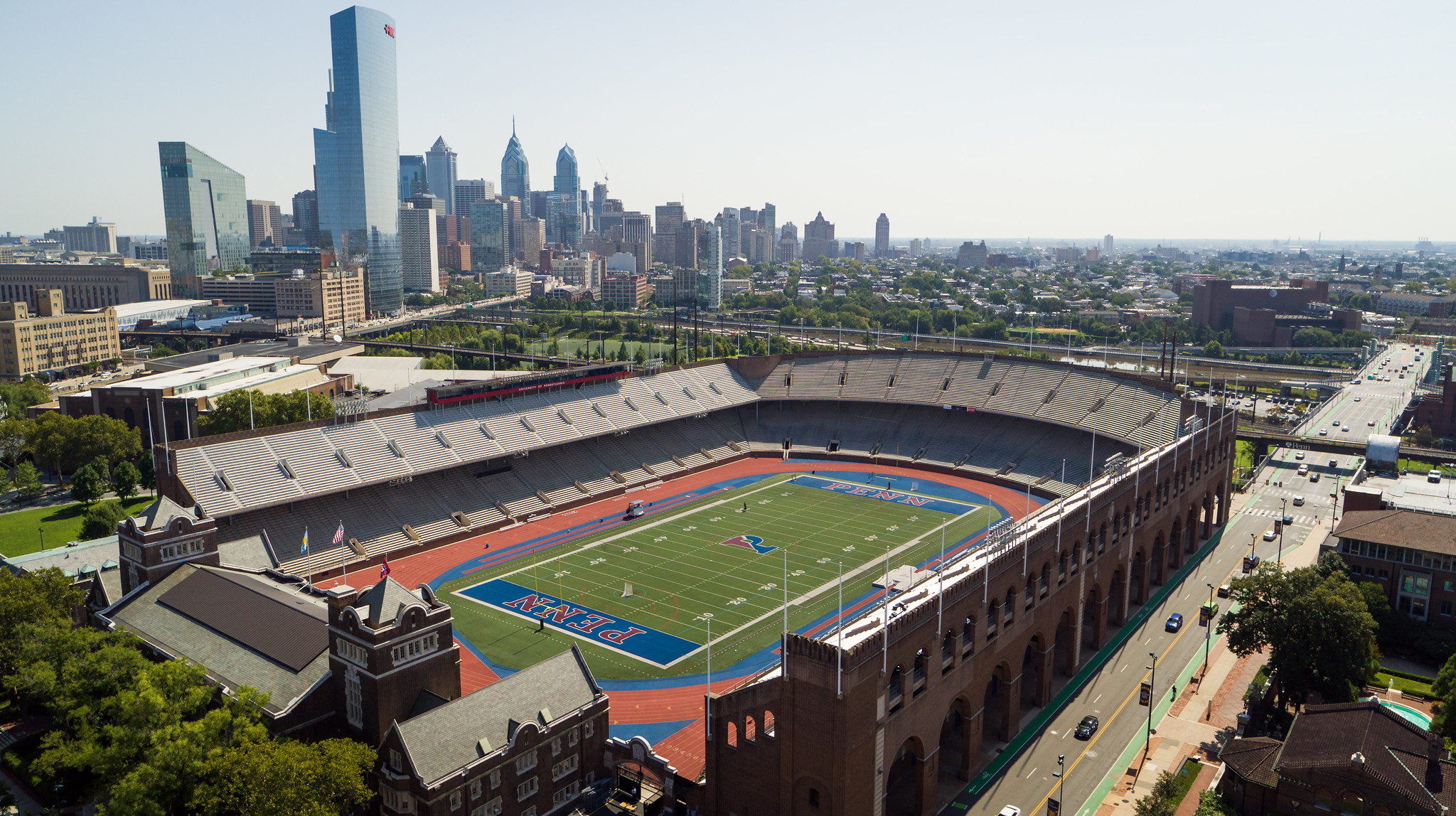
4. Franklin Field: Saturday's game is the last of an announced two game series with Pennsylvania, and it makes too much sense that these teams should play regularly, but don't. This is only the eighth meeting all time between the schools, and the fourth since 1937 .

Saturday is the fourth meeting for Georgetown at Franklin Field, and I can't say enough about how it is one of the great stadiums in the panoply of college football. 


Sofi Stadium, it is not, and that's OK. It's old, but is it majestic and harkens back to better days for Ivy League football. Gone, perhaps, are the sellout crowds (Penn averaged just 12 percent capacity last season, or 6,853 a game) but it's a fun place to watch a game, and has seen its share of great finishes. This YouTube clip from 1982 is one example--listen to the crowd of over 34,000 for this game:


Nonetheless,  Franklin Field is a shrine to over 100 years of college football, and if you've never been to a game there and can visit it this Saturday, you are well advised to do so. And yes, I hope the Hoyas can get back there soon.

5. Around The PL:  Entering week six, there are some definite story lines building.

Colgate 35, Cornell 25: The Red Raiders ended a seven game losing streak with a flourish, coming back to score 21 points in the fourth quarter for the win before a hearty Homecoming crowd of 12,525 at Cornell's Schoellkopf Field. Colgate converted 10 third downs and held Cornell to 4 for 16 on third down conversions. A tough test awaits Colgate in two weeks at its Homecoming game versus Dartmouth, but they look ready to compete in PL play.

Monmouth 49, Lehigh 7: No such news at South Mountain, where the Engineers dropped to 1-4 giving up 42 unanswered points in the rain before 3,266 at Monmouth's Kessler Stadium.  The Hawks put up 619 yards of total offense  and held Lehigh to 2 for 13 on third down conversions. Averaging just 13 points a game to date, Lehigh faces a tall order against a Fordham team looking to resteady its offensive throughput following its loss to Georgetown.

Lafayette 56, Bucknell 22; Down the road, better times at Lafayette, where a 56-22 thumping of Bucknell before an announced crowd of 4,283 at Fisher Stadium has the Leopards on a  three game win streak heading into a game at Princeton, where lots of bad luck has followed the Leopards over the years. In this game, Lafayette scored six consecutive touchdowns in the first half, and never looked back. Bucknell gets a touch assignment at Holy Cross this week.

Harvard 38, Holy Cross 28: This was no upset--Harvard took the Crusaders' best shot and emerged victorious before 7,906 at Worcester's Polar Park. Five HC turnovers, including three interceptions by Matthew Sluka, proved the difference. Only one home game remains for the Crusaders before the season finale with Georgetown, but they remain favored in every game remaining except a November 11 nationally televised game at Army.


Monday, September 25, 2023

Week 4 Thoughts


Some thoughts following Columbia's 30-0 win over Georgetown Saturday:

1. Georgetown: Still Learning. The Georgetown talent gap with its schedule continues to grow, and don't confuse Columbia with one of the stronger foes this season. The Lions are a three or four win team and will struggle defensively in the Ivy League, No such struggles Saturday, where the Georgetown offense failed to score three times inside the ten. Would it have won the game? Maybe not, but it would have made it interesting. 

Did the poor weather play a factor? Perhaps, but this was more a function of the execution over the elements.  

Columbia did its homework on the game film and shut down the Georgetown run game in the first quarter: just five running plays, -18 yards. The Hoyas had only one rushing play of more than six yards thereafter.  Even with a one-back set, the position is still vitally important because Georgetown is not strong enough in the passing game to simply pass its way down the field. With rushing accounting for 57 percent of yards gained to date this season, team that shut down the Hoyas on first and second downs leave it a narrow margin to convert on third down, where Georgetown converts on just 34 percent this season with the easier part of the schedule behind it.

Last week versus Stonehill, Fordham allowed 156 yards on the ground and it mattered not a bit--the Rams totaled 497 total yards in a 44-0 rout. Watch carefully how Fordham approaches the run in Saturday's Homecoming game: in the full scholarship era of PL football (since 2015), Fordham has allowed more than 100 yards on the ground just twice against Georgetown, and is 6-1 during that run. That's no accident.


2. The Rivalry That Isn't. Georgetown and Fordham have played 66 times since 1890, twice as much as any other opponent over those years. But is it a rivalry game? No.

A rivalry is defined by one of three intangibles: 

1) The schools compete in a specific regional area where interest is highlighted and prospective students can attend either school (think Alabama-Auburn) ; 

2) Absent the first, a rivalry indicates a shared tradition where the game is the most important contest on thee schedule (think Army-Navy);

3) Absent the first two, a rivalry  is defined by numerous memorable performances that are part of the tradition between the schools, no matter the distance or shared values (think Notre Dame-USC).

But this isn't a regional rivalry. While there may have been a time in the post-War era when the all-male classes at Georgetown were chock-full of men from Regis, Xavier, St. Francis, and Cardinal Hayes, that's long gone. Students from Washington and New York give passing attention to each other, and neither opponent is top-of-mind in their respective areas.

This isn't a traditional opponent. While the schools a common past as former Eastern powers that died in the 1950s and returned via club football and Division III, neither school gives it the gravitas of current times, particularly with each school  playing basketball in different conferences and meeting rarely, if at all, in other sports. Since 1979, the schools have met once in men's basketball and not in the past 16 years. 

This isn't, to be frank, a competitive series. Notre Dame-USC is a lively series because both teams have been very good for decades and every game seems important. A rivalry without competition is a schedule filler. Texas has played Rice 47 times since 1966 and has won 46 of them.

Fordham is 28-4 in the last 32 games against Georgetown. In games where it has scored more than 14 points, Fordham is 28-1. Why is it so uneven? 

Some of its it budget: Fordham outspends Georgetown by over $5 million a year in football expenses, and that's not inconsequential. Fordham spends 20 percent of its athletic budget on one sport: football: it's the #1 sport on Rose Hill, case closed.  Georgetown spends 5.9 percent of its budget on football, less than any Patriot League school.  

Some of it is recruiting: Fordham admits a wider range of recruits than Georgetown is allowed to do so and gets kids admitted that Georgetown can't, thanks to the arcane PL Academic Index. Fordham's top recruit from the transfer portal is a FBS quarterback from New Mexico. Georgetown's  top recruit from the transfer portal is a Division III receiver from Union. 

Yes, a lot of it is scholarships: a free ride to Fordham University is a powerful recruiting tool. But Fordham was leading this series before scholarships were an issue, too. 

For many years, Fordham just wanted this game a little more, and they have the wins to prove it. How does this change?  

It starts with a first step, and that step could be Saturday. The teams have met on 10 prior Homecoming games at Georgetown, and are 5-5 between them. The only two meetings in the Division I-AA era were settled by three points each. 

You've got to have hope, right?

3. Around The PL: The first and second tiers of the PL are playing to form.

Holy Cross 47, Colgate 7: A total of 507 yards was another day at the office for the Crusaders, sending the Red Raiders to its fourth loss of 2023 and seventh straight dating to last season before 12,578 at Fitton Field. Holy Cross has given up just two turnovers all season, and look to continue the run versus Harvard at Worcester's Polar Park. By contrast, Colgate travels to Cornell, where the Big Red came back from 14 down to win at Yale, starting 2-0 for only the second time in the last 13 years.

Fordham 44, Stonehill: A week removed from their road at Georgetown, Stonehill was run over by the aerial attack of the Rams. Quarterback C.J. Montes was 14 for 21 for 220 yards and two touchdowns, while the Fordham defense held Stonehill to 3 for 16 from third down and allowed just one possession inside its red zone.  

Dartmouth 34, Lehigh 17: The long rebuild continues at Lehigh, where it allowed 24 unanswered points for Dartmouth to take the win at Hanover, 34-17, before 3,641 at Memorial Stadium. The Engineers managed just 167 yards and were 1 for 10 on third downs, two numbers which must improve in a road game at Monmouth.

Pennsylvania 37, Bucknell 21: The Bison were no match in this one, outgained 515-238 and allowing the Quakers over 41 minutes of possession. The Penn defense held Bucknell to just eight yards and forced four sacks..

Lafayette 28, Monmouth 20: A solid win for the Leopards before just 1,497 at Fisher Stadium. Its sophomore QB  Dean DeNobile accounted for just short of half of the Lafayette total yardage, throwing two touchdown passes and running for two more. The Hawks were held to 59 yards on the ground and trailed throughout. The Leopards host Bucknell this weekend.


Tuesday, September 19, 2023

Wanted: A Strategic Plan For Georgetown Football


This week, head coach Rob Sgarlata will make his annual trek to New York and the former players reception in the days before the Columbia game, a rivalry in name if not in notice. Like most Georgetown University events, it will accentuate the positive, steer clear from the negative, and avoid change. 

Georgetown is not good at change, and is institutionally resistant to the conversation. Athletics is no different, because it waits for multiple levels of approval above before moving anything forward. The days of Frank Rienzo writing the department's seminal "Philosophy of Athletics" and getting it approved by default is ancient history.

These are times of intense change in college athletics, beginning with football. It's not enough to say "we've always done it this way" and not face some accountability for where Georgetown is in the sport today. As Eastern programs go, it's at or near the bottom,  ranking 36th of 38 FCS schools in winning percentage over the past ten seasons, and one of just two programs (along with Cornell) without a single winning season during that time. "Four for 40" didn't change this equation.  What will?

In the grab bag that is the University's capital campaign, football gets a short item in the list of giving opportunities. "Georgetown Football is seeking investments in coaching funds, the JumpStart Program, travel and recruiting funds, nutrition and sports performance funds, the Annual Fund, and a number of existing named scholarship endowments," it reads. "These investments are critical to our ability to recruit, retain, and reward the best coaches and develop our student-athletes to their full potential inside and outside the classroom, fostering a new era of competitive success for the team."

That is a wish list, but one that isn't changing the perception of football as a square peg in a round hole. Georgetown football needs a strategic plan, a measurable and accountable set of initiatives needed to navigate it in the NIL era of the sport and one where, as University president Jack DeGioia once se the course for men's basketball in his tenure as University president: "The first commitment - that our students will receive our education and they will graduate...secondly, that we do it honestly­, that we be above reproach - that we must set the standard for integrity in intercollegiate athletics, and we do, and finally, that we win. We keep score for a reason."

Two out of three ain't bad, as they say, but it's not enough. 

A strategic plan is often consigned to a university archives because they are expansive in hope and long since forgotten. More time is often spent on ideation of an organization's mission, its goals, focus areas, objectives, KPIs, etc., than actual planning itself. In many cases, there is no reward for meeting the objectives and no risks for not doing so, so Georgetown trends to avoid the exercise altogether. 

In this case, however, it offers an opportunity to address some uncomfortable truths and set some measures of success that can be afforded to deal with it.

Before we go down the rabbit hole of  "all we need is 60 scholarships", let's talk more about what a plan would entail, absent this. Here are 10 questions to engage some conversation.

1. What Is The Identity of Georgetown Football? To students, it's a team that is "is pretty awful", as one coed told The HOYA before the Marist game. To alumni, forgotten. To recruits, indifferent. To the Patriot League, an insurance policy. To Washington DC, invisible.

What could it be? Imagine a program that attracts some of the best scholar-athletes in the nation, offers networking and leadership skills above and beyond anyone in the sport, and opens the door for  opportunities in pro sports, in coaching, or in business, with a group of mentors and sponsors that can inspire them for life....and that also wins games, to the credit of the University which supports it. 

Why can't Georgetown be the civilian version of West Point football: a four year commitment which will offer rewards for a lifetime? How do we get there?

2. What Is This Program's Future In The Patriot League? The Patriot League is a gilded cage for Georgetown: low investment, low expectations, low results. Two decades of coaches have told recruits that Georgetown is competing for Patriot League championships, and that is an overstatement at best. It has won 25 league games in 22 years, in no small part to the competitive imbalance which is only growing between six schools investing in the future and one that is not.

How does that change? When does (or should) Georgetown go to the PL and ask for an admissions waiver, to take up to five recruits a year outside its SAT range known as the academic index? That won't make Georgetown a Penn State on the Potomac, but it could give this team a fighting chance when it comes to playing full scholarship teams that recruit and admit players Georgetown can't even touch. No less strategic, the University should also be prepared to have a fallback plan when the league says no. If the Patriot League won't see fit to support Georgetown, it should find an eastern conference that will.

3. How does Georgetown Football reconnect to Washington DC? The program is invisible in the city, the metropolitan area, and among its high schools. The last DeMatha player was signed a decade ago, the DCIAA ties are nonexistent, and unless a local player went to a prep school like Landon, they're not signing with Georgetown.

Washington DC and its environs provide a lot of outstanding college football talent but few if any see Georgetown as an option, whether it's the scholarship issue, the perception of the program among high school  coaches, or simply that they aren't being considered as admittable candidates. These are all fixable problems if they are identified as priorities.

Apart from alumni or parents, do local fans come to Cooper Field? No. Why would they?  So why doesn't Georgetown see its schedule as well as its roster as a form of community outreach, starting with committing to a home game each season at Audi Field or Nationals Park against an opponent that local  residents would pay attention to - - Ivy League schools do not count. By contrast, schools such as Howard, Towson, Delaware, or Villanova would. Playing at home in front of  family and friends still carries weight in recruiting, and if Georgetown can't close the deal locally, its national prospects will not fare much better.

4. How does Georgetown maintain competent staff? Earlier this year, we wrote: "The average salary of an assistant coach in FCS football is $43,387 a year, which buys you a 10 minute commute and a parking space in front of the football building at a Delaware or Lafayette. Try raising a family on $43,387 a year inside the Beltway; and as for parking, prepare to ride the GUTS bus from Arlington."  Coach Sgarlata is regularly losing young assistants on cost, and if Rob Spence or Kevin Doherty retire soon, he's got a big problem on his hands. 

Imagine the impact of a $300,000 discretionary fund raised for coaching hires. Imagine the ability to secure multi-year housing agreements for coaches with that assures their families the ability to earn a living wage in a high income city without living in another area code. Imagine the opportunities to better leverage Georgetown's master's in sports management degree to enrich the professional development of a young coach. 

Why shouldn't Georgetown be the same destination for young coaches as it can be for young professors?

5. What Is The Role of Corporate Partnerships?  Above and beyond NIL, to be discussed below, there are a lot of missed opportunities with linking up corporate and non-profit partners with the program and the players. At many major college programs, this is in the form of sponsorship - Alabama, for example, has a staff of 17 doing just that. That's not in the cards for Georgetown, but a partnership is not just a sponsorship.

Georgetown football athletes are well rounded individuals that can appeal to companies and internships from day one. Rather than chasing down internships in New York every spring, let's rethink this--corporate partners of Georgetown should be incented to offer player internships as well as professional skills that manifest as potential hiring opportunities. There are too many major firms in the local area that could offer these valuable skills without taking a serious look at how these relationships could be fostered, and how these corporations could gain by their association with Georgetown.

Back to the example above: if a local recruit knew that committing to Georgetown would not only be a great opportunity to get an education but allows the opportunity to set him up in a career locally, it's another card in Sgarlata's pocket to close the deal, especially for players who aren't looking at investment banking as their future. 

6. When To Address The Elephant In The Room? Name, image and likeness (NIL) isn't just an issue at Maryland or Michigan, it's one in FCS and teams like Georgetown are neither immune nor ineligible to address it. For every plaudit about encouraging athletes to "build their brand" comes the darker side of  NIL: the collective, the "bag", and the impact of unbridled third party funding of recruits. Let's not kid ourselves that it's not going to be an issue, even in the Patriot League.

Georgetown's approach to NIL did a 180 when Ed Cooley was hired. Hoyas Rising is not a altruistic brand agency, it is a collective, and there are clues which suggest its focus is on basketball, and really only basketball. Somewhere, Jack DeGioia and the board have tacitly signed off on a collective relationship, as if they said "this is the business we’ve chosen." Would they be as comfortable if two Clemson running backs appeared in the 2024 football roster with a five figure handshake from a third party?

There are no rules right now on NIL--Congress is debating NIL rules to head off a tsunami if the NLRB gets involved, every state has its own rules on high school NIL but the District hasn't acted upon a bill for colleges since it was placed in committee last year.  Schools can't control collectives, not should they, and so for every Hoyas Rising there could be a "Saxa Sports LLC" hovering out there which could do whatever it wished with deals and GU is left out.

Georgetown is not at a point where, compared to a place like Texas Tech, where a collective will offer $25,000 to every football player as a matter of course. That's not Georgetown, but GU does need a communicated plan in place regarding what NIL really means beyond the "don't ask, don't tell" model emerging across men's basketball. 

Again, let's not kid ourselves that it's not going to be an issue in football, even in the Patriot League. There will be a collective at Colgate and probably at Fordham within three years.

7. Is There Campus Engagement? Right now, there isn't much of this. It's not the coaches job to stir up promotional interest, but the Athletic Department still operates under a John Thompson Era tiering of sports when it comes to campus promotion:

  • 1. Men's Basketball.
  • 2. Everyone Else.

Football doesn't have a lot of time to stir up interest: half the home schedule has already been completed, and it's already the third week of September. Many students arrive without the slightest awareness of sports at Georgetown beyond men's basketball, which they communally understand is bad right now and may or may not get better soon. Their views of football, are even less so, and the opponents are wholly dissimilar to anything they expect a school like Georgetown to be competing among.

What is the time, talent, and expense that the University wants to invest in a positive pre-game, in-game, and post-game experience for students and fans visiting these games, and create a simple call to action that attending these games is a positive, community building experience? This is a strategic issue, and ought to be treated as such.

8. Whither The Gridiron Club? Approaching its 50th anniversary in 2024, the Georgetown Gridiron Club is more of a parents club right now, as the University has not accentuated the need for alumni and fan membership in its support club structure. At one point there were over 2,000 members of the Hoya Hoop Club and that number today is a fraction of that total. 

Put another way, how many people from your class talk about being in the Hoop Club?

With membership comes privileges, and this too has eroded over the years. What is a "membership" in the Gridiron Club all about? If you give $25 to the Gridiron Club, what is that worth? How about $2,500?  How about $25,000? Fan events outside of tailgates have been inexorably cut out, the end of season banquet went the way of COVID, and, like many universities, Georgetown has dialed back the recognition portion of giving as an unnecessary expense, when it's not an expense at all--it's an investment.  Remember the adage about giving a man a fish versus teaching a man to fish? Telling someone to give money returns a gift for one year. Teaching a man the value of giving provides returns for a lifetime.

In an age of NIL and a University which would prefer you gave to programs outside Athletics, it's worth a larger discussion as to how to position the Gridiron Club to support the long term success of the program.

9. How Does GU Address Financial Planning? In some ways, Georgetown was wholly unprepared joining the Patriot League and the PL looked the other way. And that's still the case. 

No matter how you view the utility of the non-scholarship model as one of just two non-Ivy schools that still maintain it, the University needs to understand what football needs going forward and the delicate balance of  intra and extra-University support needed to accomplish its objectives. Georgetown  spends too much on men's basketball but its spending is tied to a strategic approach to being nationally competitive. This is not always wise or effective (more money was paid to Patrick Ewing in 2022 than the entire football budget) but it is a external signal that Georgetown will compete at the highest levels of the Big East Conference.

The opposite is true in football. The numbers in 2022 show a growing gap between the haves and the have-not (have-not is singular, because it's Georgetown): 


Georgetown is not going to double it football budget - if it did, it would still be in last place. However, some degree of institutional planning is needed as to where the budget could better support some of the issues discussed above, and where philanthropic support would be most effective.

If GU allocated, say, an extra $100,000 to football over and above cost of living increases, where are the impact areas? If the Gridiron Club committed to covering operating expenses, where does that open up room for targeted growth elsewhere? If GU is not committed to competing at anything close to the top of what is, in many respects, a bottom tier league in FCS football, where can they compete under this budget?

10. Do We Revisit the Mission?  At its core, a strategic planning process is an opportunity to align expectations with aspirations; in other words, to tie what we seek with what we can deliver. For athletic teams, that is often defined by a win-loss record, secondarily by off-field recognition, and tangentially by academic honors.

In 2022, Georgetown had 45 players earn a 3.2 or better in the classroom...and won two games in the process. Each has its own place in the expectation set but they are not mutually exclusive (Holy Cross, for example, had 36 all-academic selections en route to a 12-1 season).

The core values of Georgetown athletics, as noted on its web site, include the following: integrity, mastery, winning, community, and formation. I would add these four outputs:

  • We are committed to our students throughout their academic and athletic pursuits;
  • We are supportive of each other, on and off the field;
  • We are committed to setting the highest standards in everything we do; and 
  • We are accountable for our results.

Is there the structure in place to excel with these? I would suggest there is, but the future demands more than suggestions, but commitments. This starts with discussion.




Monday, September 18, 2023

Week 3 Thoughts


Some thoughts following Stonehill's 23-20 win over Georgetown Saturday:

1. Back to Reality:  Two weeks of relative ease over the likes of Marist and Sacred Heart (a combined 0-5)  were tested in a young and unfamiliar Stonehill team, and Georgetown did not pass this test.

The score was close, and the game was as well, but this should not have been close. A defense that was admittedly a starter down on the line was largely ineffective, giving up four drives of ten or more plays, accounting for all 23 Stonehill points. The Skyhawks were 9-16 on third downs, out-toughed the Hoyas in a number of key sequences, and were not seriously contained after halftime, punting the ball just once after the break. Any illusion about Georgetown as the top ranked defense in FCS, though statistically accurate, 2 was unfounded, and as the Hoyas take the clubhouse turn of the 2023 schedule , its defense must be more attuned to limiting the run and forcing opponents into turnovers. 

Last season's matchup with Columbia was an especially frustrating one as the defense goes. The Lions were 14 of 18 on third down conversions an 4-5 in the red zone en route to a 42-6 win. The awkward rushing numbers from that day (Columbia 201, Georgetown 0)  are not to be repeated if GU wants to stay close in this one.

Offensively, the Hoyas made no progress against the Skyhawks after the opening drive of the second half, and collected two first downs in the final 17 minutes of the game against a Stonehill defense giving up 260 yards a game on passing defense, but the Hoyas finished with just 175. The Hoyas have just two pass plays in 2023 of more than 20 yards, and it can't merely rely on short passes to make progress in late game drives.

There were some positive signs in the game, particularly on the ground, where the offensive line is giving Joshua Stakely and Naieem Kearney opportunities. Tyler Knoop is efficient in the short passing game, and was 13 of 14 by halftime.  Columbia is not Stonehill, however, and  the offense must take another step forward, as 20 points will likely not win this week's game.

2. Can The Special Teams Be Fixed? Of Georgetown's concerns heading into the Columbia and Penn games, the early returns on the special teams are not promising. Patrick Ryan's kickoff game has struggled, averaging just 52 yards a kick  with no touchbacks. Richard Abood has not made a field goal outside 25 yards. The Hoyas are 90th of 122 schools in kickoff returns--not unexpected after losing Joshua Tomas, but a point of concern regardless. 

Field possession is an output of special teams and this must be a priority heading into the Columbia game. Six of the Lions drives last week versus Lafayette did not pass midfield, and there of its drives resulted in negative yardage. By contrast, Lafayette started seven of its 11 drives in CU territory. Georgetown only pinned back the Skyhawks twice last week, and while Stonehill deserves credit for executing on its four long drives, shorter fields always work to the benefit of an offense.

3. What Would I Do? Reposting a conversation from the HoyaTalk board this weekend I argued that the 20 years of Georgetown facing Ivy League opponents has been, at best, unproductive:

This is the 20th anniversary of Georgetown's first Ivy opponent. Since then, two trends are apparent:

Georgetown is not competitive with these teams: a combined 6-32 (.157), or 4-8 versus Columbia and Cornell and 2-24 vs. everyone else, including an 0-fer vs Harvard and Yale (0-11). If Georgetown is "modeling" the Ivies they have largely failed to do so. After 2024, just one Ivy remains on published future schedules and a number Ivy schools simply don't want to play GU because the games are not competitive and Cooper Field is not a draw for their fans. No one considers Georgetown as a rival with any of these schools.

Nearly every Ivy school can now offer a no-loan, no-parent contribution offer to applicants with a household income under $100K. Georgetown cannot, and shows no institutional mandate to do so. In that sense, there is a disincentive for Ivy level athletes to attend Georgetown because it does not match offers received elsewhere (including six other PL schools), and I would suspect that Ivies lose comparatively few top athletes to Georgetown as a result.

I'm not arguing for 60 scholarships, and never really have. A Georgetown program with 60 scholarships is merely Bucknell without meaningful admissions reform by the Patriot League, and GU's place in the current PL may be a bigger hindrance to winning than being an Ivy League tagalong. But if Georgetown sees that it can aspire to be no more than Brown and Columbia for some sort of academic purity test in one sport (but curiously, no other), or that scheduling opponents outside three conferences are against the ethos and culture, it will not improve."

A reader asked: "What would you do if you had reasonable control of things like scholarship amounts within reasonable financial limits? Leave the Patriot League if they don’t even want to consider admissions changes? Where would we go?"

This blog has offered its share of ideas, thoughts and suggestions over the years to address this imbalance, most of them understandably ignored. Georgetown accepts a lot of losing out of football in the context that they do not fund it to the standards of other  FCS schools, even Ivy League schools. Patriot League schools outside Georgetown spend between $6.3 and $7.8 million on football, and Georgetown stands at $2.7 million. Even among Ivy schools, Georgetown trails all eight.

So what would it take to change a 20 year equation? Check back here tomorrow for just such a proposal.

4. Around The PL: Some good returns for the PL teams in week 3:

Holy Cross 49, Yale 24:  After nearly upsetting Boston College the week before, Holy Cross was back on track towards an 10 win season. QB Matthew Sluka  completed 76 percent of his passes for 275 yards and punted just once in the 25 point win before 4,968 at the Yale Bowl. The 2-1 Crusaders take on winless Colgate (0-3) in the league opener Saturday.

Lehigh 23, Cornell 20: The Big Red dropped their opener in a game where the Engineers  scored two touchdowns in the final 4:02 for the win before 4,087 at Goodman Stadium. Despite outgaining Lehigh 401 to 239, Cornell settled for second half field goals where they needed touchdowns, and credit goes to Lehigh for staying the course for the win. The Engineers travel to Dartmouth (0-1) this weekend.  

Lafayette 24, Columbia 3: An early field goal was all the Lions could muster as the Leopards got 145 rushing yards from Jamar Curtis and Lafayette outgained Columbia 392-157, without a punt after halftime en route to the three touchdown win before 4,523 at Fisher Stadium. Early returns are promising for the young 2-1 Leopards, who host Monmouth this week.

Pennsylvania 20, Colgate 3: With an opening schedule that included Villanova, Syracuse, and Penn, an 0-3 start wasn't out of the question at Colgate, and the Red Raiders are right there now. Colgate managed just 60 yards on the ground and missed on thee fourth down conversions in the second half, never challenging thereafter before 3,628 at Andy Kerr Stadium. Another loss start seems all but likely at Holy Cross, which would be Colgate's first 0-4 start since the 2019 season, where it finished 3-8.


Monday, September 11, 2023

Week 2 Thoughts


Some thoughts following Georgetown's 27-10 win over Sacred Heart Saturday.

1. The Longest Game: Maybe Dave Goracy or Rob Sgarlata may remember otherwise, but I am hard pressed to recall a longer game from beginning to end that Saturday's five and a half hour slog. 

Georgetown wasn't alone in weather delays, which predominated in a band from northern Virginia through the Route 128 corridor outside Boston. What it did have, at least for this Saturday, was a commanding lead that did not give its opponent a window to climb back into contention, a role that few Georgetown teams have enjoyed in recent years. 

That role, however, is supported ably by a running game that has been lacking in prior seasons but which holds some hope for the future.

Two able and contributive running backs opens up opportunities for a Georgetown offense which traditionally gets boxed in the backfield and must resort to passing to stay competitive. More often than not, it comes back to bite them. While two games is not a representative sample, and Marist and Sacred Heart are certainly not Maryland and Syracuse, the pair of Joshua Stakely and Naieem Kearney have combined to average over 200 yards a game rushing between them. This allowed Georgetown a whopping 40 minutes of time of possession Saturday, and Kearney's 54 yards in the third quarter were an exemplary use of  the backfield to control time and distance. 

A third game against a manageable opponent offers the opportunity for more of the same, and that's good not only for the backs, but the entire Georgetown offense.

But perhaps numbers tell the story even better: In 2022, Georgetown managed just 901 yards as a team. Through two games, Georgetown as a team already has 566.

2. "A" For The "D" : Again, take the strength of schedule off the able, but a veteran Georgetown defense has been very efficient at limiting opponent drives and  has tipped the field back to the offense. In two games, the defense has met the opponent in 24 possessions, and allowed points in just three of those possessions. It has forced a turnover in six of those 24 possessions, and while we're at it, has kept opponents out of the red zone, with just two red zone possessions in the past two games and a shutout in Saturday's game. Rain notwithstanding, when was the  last time a Georgetown opponent failed to get into the red zone? 

Also a decided plus after two weeks: penalties. After two games, penalties are down 20 yards per game from 2022, and those are numbers that, if maintained, can be the difference in close games.

3. Perception Is Reality. Another small crowd, pre-rain, greeted  the teams Saturday. Call it a lack of promotion, call it a lack  of interest in Sacred Heart, or call it a student body that has been acculturated to expect the worse.

“I heard we were like really bad, but I guess we’re better than Marist,” said  Laura Taylor, a freshman from McLean, VA in a quote to The HOYA the week before. "I was very surprised when I came in and we were winning already."

Was she and her friends at the game Saturday? Will they be back?

I have spoken at length about the soft bigotry of low expectations around Georgetown football, and how students are not engaged with this team the way, they are with, say, men's soccer. Winning helps, of course, but so does the ability to enjoy the game. While Cooper Field is a step above the ramshackle MSF, which itself was a step above the roof side seating at Kehoe Field, it means absolutely nothing to 18 and 19 year olds who have no memory of these former environments.

Saturday's home game is the third of the season and the halfway point as far as home games go and students aren't going to overfill those seats organically. This is a generation that is connected virtually but disconnected socially, and school spirit is in short supply if it was never offered by the school in the first place.  

Keynote speaker Jack Mackey defines a positive customer experience as "a partnership between architects and heroes" to win loyalty, and there are any number of theoretical and academic exercises to engender student interest in an extracurricular activity. There are few architects on the Hilltop committed to this, and heroes are always a week away.  

But  in four words, the salient point was made by William F. Buckley: "First, you must win."

Georgetown hasn't won there consecutive home games in 12 years. Let's start with that on Saturday.

4. Hoiah, Holy Cross: If you haven't read about the finish of Holy Cross' 31-28 loss to Boston College this past week, you should. It was an epic game and a heartbreaking defeat against a generations-old rival, one which Georgetown utterly lacks. If you can imagine a Georgetown football team being down three to Maryland with under two minutes left at Byrd Stadium, that may be as good an analogy as any.

Even in defeat, HC fans could hold their heads high. These three images posted in social media  tell the story of a school less than half the size of Georgetown come together in ways that a mere Patriot League game could never do. The wounds may still be raw, but this was the stuff of memories that these students will be talking about for decades to come.


5. Elsewhere In the PL: Unexpected progress for the league in week 2:

Bucknell 21, VMI 13: A 7-0 game through three quarters, the Bison held the Keydets to just 30 in their final two drives of the game and took the win at Lewisburg before 1,465. A home test with Penn in two weeks will say a lot about where the Bison can go offensively versus a FCS top-five defense; for now, it's a bye week.

Lehigh 14, Merrimack 12:  This game was not only rain delayed, it was rain-relocated, as poor conditions in Andover led Merrimack officials to move the game to Harvard Stadium where the game could be played (and finished) under the lights. Two hours delayed, it took two drives to end the first half to serve as the margin of victory before 1,652 in Cambridge. A drier and more familiar venue await the Engineers in a home game versus Cornell.

Duke 42, Lafayette 7: No let-up for the Blue Devils following their Labor Day walloping of Clemson. The Leopards were even after the first quarter but Duke pulled away thereafter and put up 515 yards total offense before as smaller than expected crowd of 17,481 in Durham. Lafayette held its own and this should prove beneficial when arranging future games against major college opponents. This week, a home game with Columbia.

Villanova 42, Colgate 19: Another tough test for the Red Raiders with predictable results. The Wildcats scored touchdowns on its first four possessions of the game, with Villanova QB Conor Watkins throwing for 130 yards on 8 for 11 passing before 5,101 on the Main Line. The only winless team in the PL, Colgate hosts Penn this weekend.

Fordham 40, Buffalo 37: C.J. Montes isn't Tim DeMorat but he's making a name for himself all the same. In his last two games the New Mexico transfer has thrown for 628 yards, and a sterling 23 for 36, 309 yard effort versus the Bulls resulted in five touchdown passes Saturday, including the game winner with 2:32 to play before 15,854 at UB Stadium. The Fordham defense still has its issues, but an off week gives them time to prepare for games with Stonehill and Georgetown in consecutive weeks.