Sunday, September 23, 2018

Week 4 Thoughts

Some thoughts following Columbia's 23-15 win over Georgetown Saturday.

1. Then and Now. Consider this: on September 24, 2016, leading by a comfortable 17-0 at halftime versus Columbia on Homecoming Day at Cooper Field,  hung on to a 17-14 win for its third straight victory to open the 2016 season.

Columbia had lost its fifth straight game, and left that game with a combined record of 2-30 over its last 32 games.

Two years later, Columbia led 23-0 versus Georgetown on Homecoming Day at Cooper Field, and hung on to a 23-15 win Saturday for its second straight to open the 2016 season.

Since that 2016 loss to Georgetown, the Lions are 13-7 and winners of 10 of its last 12. Over its last 23 games since that game, Georgetown is 2-21.

There's no one explanation why Columbia has soared and Georgetown has soured. Al Bagnoli has a lot to do with the Lions' resurgence, as well as a commitment by that school to end the stench of decades of bad football on Baker Field.

"We are all people who aspire to do the very best," said Columbia president Lee Bollinger when Bagnoli was hired. "We have done that throughout the athletics program, and we're going to do it in football," he said.

More than aspiring, Columbia is delivering. Georgetown aspires, too, of course. But 2 and 21 is not delivering.

2. Play of The Game:  From Jake Novak's Columbia football blog, "Roar, Lion Roar":

"With 2:15 left in the 3rd quarter and Columbia now ahead 13-0, PK Chris Alleyne was called on to kick a 46-yard FG when a Lion drive fizzled at Georgetown 28. Alleyne nailed the kick to keep his perfect season going and gave Columbia a crucial two-score lead." he wrote.

"On the ensuing Hoya possession, DE Daniel DeLorenzi strip sacked Johnson and Lion LB Michael Murphy recovered the ball at the GU 29. Three plays later and with Columbia facing a 3rd and 18 at the Hoya 37, Smith made a beautiful run after the catch for a crucial 25-yard gain to the Georgetown 12 with about 14 minutes left in the game. Three plays later, Columbia was up 23-0 and seemingly in the clear."

That Georgetown could mount a 15 point comeback in the fourth quarter is commendable, but how different would the final minute have been if they were down 16-15 instead of 23-15?  Johnson's fumble and the five play drive to open the fourth provided Columbia an unlikely but invaluable cushion to ride out of town with the win.  

Georgetown's eight fumbles in four games ranks them dead last in the subdivision for  fumbles allowed after week four. Brown has not allowed a fumble all season.


3. Rush Week: Want one reason why Georgetown is such a poor performer in games like this? It can't run the ball. Saturday's game saw the Hoyas carry 26 times for 25 yards against a Columbia rushing defense ranked fourth in the subdivision. Georgetown has dropped to 118th of 124 schools in rushing;  a small consolation, perhaps, that three Patriot League schools join Georgetown in the bottom ten, another sign how poor this conference is in 2018, with a combined out of conference mark of 5-20 through week 4.

A slight ray of hope lies across the field at Brown Stadium this week. The Bears have struggled to contain the run against better competition--it allowed 420 yards to  against Cal Poly and 237 yards versus Harvard. 

Can Georgetown resuscitate the run? If so, it needs a stronger effort out of its offensive line, one which can move the line of scrimmage and something it has not shown it can consistently do. Georgetown's longest run from scrimmage Saturday was six yards. And while it might seem like a tall order to a school who hasn't had a serious RB threat since Kim Sarin, Georgetown has to work the run game even if it won't succeed. Short of repositioning Khristian Tate to the backfield, it has to get more out of Jay Tolliver and Jackson Saffold if only to keep the Brown defenses honest. Harvard has three rushes of 20 yards or more on the brown line, including runs of 43 and 50 yards. 

4. Next Men Up: A shoulder injury to Michael Dereus in the Columbia game is bad news for a passing offense which has yet to reach expectations. Branden Williams figures to get additional defensive scrutiny Saturday following his 1221 yards versus the Lions,  but what can be done by the receiving corps?

Georgetown has five excellent wide receivers in its rotation (Williams, Edwards, Jackson, Tomas, and Springs), with Isaac Schley at tight end. It's tempting to ditch the run and let it all air out, but Johnson does not have the time in the backfield to do that because of the offensive line. If he does, however, let it fly...and not for five yards, either.

5. A Long Way from Georgetown: Buried in the online agate type of the week, a remarkable finish in Norfolk, where Old Dominion not only got #18 Virginia Tech to play at Foreman Field, they beat the Hokies 49-35. It was not only the biggest win in that school's nine year football history, but worlds away from 2009, when the biggest game on its schedule was a Oct. 31 game versus Georgetown, won by the Monarchs 31-10 before 19,782, what remains the largest crowd to see the Hoyas play in the modern era.

Blake LaRussa, from Bishop Sullivan HS in the Tidewater, threw for 495 yards in the win.


How much have these programs diverted in the intervening years...

So why did the Gobblers play in a 20,000 seat stadium in Norfolk? Former coach Frank Beamer once said that "If we have an opportunity to play schools within the state, we’re going to do that...That program has great potential. Old Dominion is located in a good market, and the high school football there is outstanding. They’ve got a chance to recruit very good players there."

“What coach Beamer did told people in the ACC it was OK to schedule us,” said ODU athletic director Wood Selig. “It did so much to help us transition our program.”

The ODU-Virginia Tech series will continue from 2022  through 2031, with home and away games throughout. ODU will be tearing down its 1930's era stadium after the 2018 season for a full rebuild by the 2019 season, and you can bet the west side won't be a pile of sand for the home opener.

Some clips from Twitter, which just goes to show what football can do bring a campus together.


Wednesday, September 19, 2018

Week 3 Thoughts


Some thoughts following Dartmouth's 41-0 win over Georgetown Saturday.

1. No Silver Lining. This was, from the first play right to the end, a poor effort and performance. If this was in Washington, the half-crowd at Cooper Field would have deserted the place. Missed tackles, missed assignments and a general lack of progress should be of concern from the staff right on down.

In some respects, this harkens back to last year's stuffing at the hands of Harvard, with the only difference in the scoring between an errant snap on a punt that accounted for points for Georgetown where none such existed in Hanover. Harvard was, and we can agree on this, a much more dominant foe that day, and yet, while Dartmouth was certainly favored in this one, it was a 6-0 deficit with 3:00 to go by halftime. Thinks slowly but decidedly fell apart and while the defense couldn't save the day, they weren't prepared to avoid it, either.

Offensively, lots of questions. The offensive line makes it impossible to tell if the Rob Spence play calling will be able to leverage some of the better receivers Georgetown has had in a decade, or if the coaching touch he developed at Clemson is all gone at this point. Without a running game, something Georgetown has  struggled with for much of the last 15 years, opponents can flood the secondary and dare Georgetown to do something, while its front line given Gunther Johnson precious little time to check off and find receivers. Johnson was effective against Marist because he had time.  Johnson didn't have it against Dartmouth, and doesn't figure to have it Saturday with Columbia.

2. Fewer Ivies: For the past four seasons, Georgetown has been one of two PL schools to enjoy a "maximum green" of sorts on its schedule; namely, the maximum of three games against the Ivy green schools per their ten game schedules. It what Georgetown long sought for its program, and even the losses are looked upon secondarily to be able to tell recruits, parents, and fans that "we play the Ivy League".  (The other PL schools can talk about BC, Syracuse and the Academies, but that's another topic.)

A look at future Ivy schedules, however, shows that the maximum green may be dimming or Georgetown.  Just two Ivy games, road games with Columbia and Cornell, have been announced in 2019, one in 2020, and one in 2021. Of these, only one is a home game--Columbia in 2020.

Will more games follow? Probably, but the Ivies are diversifying its schedules beyond the patriot league and while they hold no particular animus to Georgetown, games like Saturday do not promote the idea that playing Georgetown is a good game for their  schedule. Some of these fan bases look upon Georgetown the way GU football looks upon Davidson.

Here's the Georgetown year by year count versus the Ivy League:

2005: 0-2 vs. Ivy, 4-5 all others

2006: 0-2 vs. Ivy, 2-7 all others

2007: 0-3 vs. Ivy, 1-7 all others

2008: 0-2 vs. Ivy, 2-6 all others

2009: 0-1 vs. Ivy, 0-10 all others

2010: 0-1 vs. Ivy, 4-6 all others

2011: 0-1 vs. Ivy, 8-2 all others

2012: 1-2 vs. Ivy,  4-4 all others

2013: 0-2 vs. Ivy, 2-7 all others

2014:  1-1 vs. Ivy, 2-7 all others

2015: 1-2 vs. Ivy,  3-5 all others

2016: 1-2 vs. Ivy,  2-6 all others

2017: 0-3 vs. Ivy, 1-8 all others
Total: 4-25 vs. Ivy, 35-80 all others

Davidson is a cautionary tale for Georgetown  in many ways, but the schedule is one of them. The Wildcats have not won a non-conference game  against a Division I opponent since 2005 (against Georgetown) and, facing a 9-57 record since 2012, have built its 2018 non-conference schedule solely against Division III teams. This weekend, Davidson put up 91 points on winless Guilford College.

Georgetown needs wins, but not cheap ones.

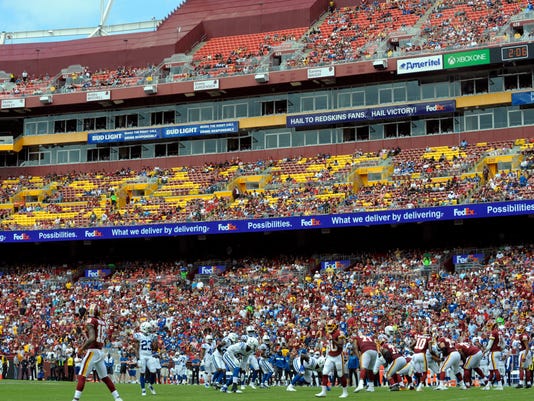
3. " A Revolution"? Were you at Sunday's Redskins-Colts game,  with two fan bases close enough where a sellout was wholly expected?

In fact, the attendance was so poor, Redskins management abandoned one of the biggest fibs in sports - the Redskins had consecutive home sellouts since 1967-- and reported attendance of just 57,013 in the 82,000 seat House that Jack Kent Cooke Built.


That's 30,000 empty seats, and it may not be the end of it.

"This is a big deal locally here in Washington, D.C.,” said Tony Kornheiser. “They couldn’t announce [a sellout] because there were 30,000 empty seats. The top deck [Sunday] looked like the Miami Marlins' games. It was awful."

"For 50 years, they owned Washington, D.C. There’s a combination of a bad team, a dull team, a terrible in-game experience, a sense that you’re being gouged and unresponsive management. And Mike, this is beginning to feel like the beginning of a revolution."

And a lesson for Georgetown. As Cooper Field is more and more de minimis, the absence of a game time atmosphere and a reason for Georgetown's Generation Z to commit three hours to a football game and not to Spotify or Snapchat is even less relevant.

Say what you will about the fact that SEC or Big 10 schools are a different culture than blue-state DC, their games are a singular in-game experience, from the tailgates to the marching bands to those 1950-'s era pom-poms that every coed seems to wave in unison. These are the proverbial ties that bind.


They get it. Does Georgetown?

What kind of game day experience at Cooper Field will bring people not just to say hello to friends, but hello to the third quarter?

The 2018 home schedule is a write-off. How do we get them back in 2019?

To be continued.

Sunday, September 9, 2018

Week 2 Thoughts


Some thoughts following Campbell's 13-8 win over Georgetown Saturday:

1. His Name Was Rocky Reid: This loss wasn't about the rain, wasn't about missed field goals, wasn't even about the all too predictable fourth quarter turnovers that bite Georgetown as much as anyone.  This loss was about Campbell running back Rocky Reid; namely, they have a player like Reid and Georgetown does not.

Most, OK, all Georgetown fans did not have a clue who Rocky Reid was and most still don't... unless he was some 6-7 forward from a fly-by-night prep school with his own YouTube Channel.  Rocky Reid is a 6-0 230 lb. running back from Concord, NC who tore apart his school's rushing records with 7,700 rushing yards and 90 touchdowns, but was still rated no more than a three star recruit.  per the Campbell media notes, "carried the ball 300 times for 2,734 yards and 38 touchdowns as a senior." If you're doing the match , that's a 9.1 yard average.  Attracting some initial interest from Louisville and West Virginia, he committed closer to home at Wake Forest in 2014, and therein began a pattern all to familiar to major college football.

Reid could have played as a freshman, but an ankle injury led to a redshirt for the 2015 season.  In 2017, he rushed  16 times for 47 yards against Delaware in week three of the season but only six carries for seven yards the remainder of the season.

Rocky saw the writing on the wall. Wrote a columnist at SB Nation:

"Reid could not break out in 2016, as Wake’s duo of Cade Carney and Matt Colburn carried the load, and both were underclassmen. The staff is also very high on Arkeem Byrd, who redshirted this year and should make a strong impact in 2017, which makes it difficult to see Reid getting significant playing time in 2017."

Staying close to home, he signed up for Campbell, which was giving out scholarships for the first time in 2017, but it came with a catch: because the  Camels were still in the Pioneer in 2017, it had to redshirt all its scholarship adds, so Reid sat a second time and effectively lost a year of eligibility.

Reid made his debut in the Camel's walkover with Chowan, rushing 14 times for 59 yards. But with the Camels' offense in first gear following a 6-3 halftime score, coach Mike Minter let Reid loose and he simply wore down the Georgetown defense in the second.

Reid carried 29 times for 115 yards, much of it in the second half. (By contrast, no Georgetown player has rushed as many times in a game the last 13 seasons.) Here's the play by on Campbell's last scoring drive.

Campbell took over at 10-6 with 13:42 to play.
1st and 10: Reid for three.
2nd and 7: Reid for seven, first down.
1st and 10: Reid for three.
2nd and 7: QB Daniel Smith for 11, first down.
1st and 10: Reid for five.
2nd and 5: Reid for two.
3rd and 3: Reid for six, first down.
1st and 10: Reid for five.
2nd and 5: Reid for three.
3rd and 3: Reid, no gain.
4th and 2: Field goal at 7:06.

Nine of ten carries by Reid ground out 36 yards but more importantly, 6:36 off the clock. It's what running backs do, except at Georgetown.

Since the start of the 2016 season, Georgetown as a team has rushed for 100 or more yards just four times: 148 yards versus Davidson in the 2016 opener (won), 150 yards against Marist the next week (won), 118 versus Harvard in 2016 (lost), and 135 yards against Bucknell in 2017 (loss).  

Two and two? Not bad.  And in games where Georgetown has rushed for 100 or fewer yards since the 2016 season, the record is 3-17. One would presume, therefore, that a power running back would have been a priority for the Hoyas in 2018 given the absence of  Alex Valles and Isaac Ellsworth to graduation, and Christian Bermudez's pass on his senior season.

Georgetown only recruited one RB in a class of nearly 30:  Herman Moultrie III, who, at 185 lbs. (45 lbs. lighter than Reid) rushed two carries for one yard Saturday.  And while he's three years younger than Rocky Reid, Moultrie fits the pattern of the undersized, underutilized running back approach that has  led Georgetown to the bottom of the rushing statistics for years.  With Carl Thomas' injury, GU is down to essentially three RB's--by contrast, Campbell, by no means a dominant team, carries seven. And Dartmouth, who awaits the Hoyas next week, carries nine.

I have no idea if Georgetown ever recruited Rocky Reid  - we do not know his grades, his interest in leaving the state, or just that transfers rarely make an impact at Georgetown, assuming they get on the team (e.g., Jon Coppens). In any case, Campbell's game was yet another example, that depth and recruiting weighs heavily on this program, one where the defense keeps the team close, the special teams gives them hope, but the offense does neither. Georgetown must rely on outcomes where Gunther Johnson can get a break, as was the case with Marist.

But there are no more Marists on the schedule, and Dartmouth knows that there are no Rocky Reids in the Georgetown backfield.

2. Around the Patriot League: Well, it wasn't fun.

Holy Cross visited Boston College for the first time in 32 years en route to a 62-14 walkover, one so convincing that the Boston Globe called  the Crusaders "a combination punching bag and sparring partner" for the homestanding Eagles. BC running back A.J. Dillon gained 149 yards on his first six carries and sat the remainder of the game. BC led 28-0 and brought in reserves as early as the second quarter.

Fordham was clocked at Richmond, 52-7, rushing for a net -3 yards and being outgained 585-188.

William & Mary defeated Bucknell, 14-7. Per the post-game notes, the Tribe is 6-0 all-time vs. Bucknell and 25-9 against the PL as a whole.

Lafayette was no match for Delaware, 37-0, as the Blue Hens held the Leopards to -11 yards rushing en route to a 414-118 edge in total yards.

It wasn't any better down the road, where Lehigh dropped to 0-2 in a 31-9 loss to Villanova before just 5,100 at Murray Goodman Stadium. Of immediate concern: RB Dom Bragalone was knocked out of the game. Assuming he is cleared for next week, the Engineers now travel to Navy.

The lone PL win was Colgate over New Hampshire, 10-3. The Red Raiders traditionally start slow, so its start has to be a good sign for Colgate this fall amidst a resolutely poor week for the league.

What hath scholarships wrought? Better opponents, but not better results.

3. Around The Ivy League: It's week three for the rest of college football but week one for the Ivies, with Dartmouth hosting Georgetown in the final game of a two game series. Georgetown is not on any future schedules for the Indians through at least 2023. Dartmouth was picked sixth in the eight team pre-season poll but Ivy teams don't ever seem to be concerned over Georgetown anymore. Since 2005, Georgetown is a combined 4-24 versus the Ancient Eight.

4. Announced Attendance: Saturday's attendance at Cooper Field, less any seating whatsoever on the west side, was announced at 1,837.

No further comment required.


Monday, September 3, 2018

Week 1 Thoughts

Some thoughts (and grades) following Georgetown's 39-14 win over Marist Saturday:

1. The A's: This is one of those games where knowing your strengths (and your opponent's weaknesses) paid off in a big way. Marist didn't have the depth to stay with Georgetown and it showed. And unlike some years where Georgetown sunk into the mud playing the game Marist wanted, getting Gunther Johnson time to find his receivers opened this game up in a big way.

Defensively,  Georgetown did all the right things, especially in holding Juston Christian, Marist's top receiver and arguably its best offensive weapon, to just one catch for eight yards.

Gunther Johnson's 369 yards is a career best and likely a season high. Defenses will adjust to the GU game plan, something Marist was conspicuous in not doing, and limit his ability to find receivers with ease.  The offensive line did a great job of giving Johnson time to find receivers and best of all, kept him healthy.

Finally, a hat-tip for the early two point conversion. Too many times, these come at the wrong time for Georgetown and it opens the door back up, but 11-0 closed that door early and the third quarter points put the game away...and that's not a phrase that Georgetown fans hear a lot these days.

2. The B's: Georgetown's rushing defense, holding Marist to 61 yards on 30 attempts. Better yet, holding the homestanding Red Foxes under 25 minutes in time of possession and 4 of 14 on third down.

3. The C's: Georgetown's rushing game isn't very good, and there will be weeks where it will be even less than that, but it did what it needed to do Saturday after losing Carl Thomas in the second series. Thomas' availability won't be reported by Georgetown so we'll have wait until Saturday to see when or if he returns.

Two fumbles, one on the verge of a Georgetown score, and one which led to an easy Marist score, need some attention. Neither were vital to the outcome of the game but each was preventable and coachable.

4. The D's: Special teams. Two missed field goals and a blocked punt is clearly not the expectations placed on Brad Hurst as a team leader. He can do better, and must do so.

5. The F's. None.  Breaking a 10 game losing streak was a team effort, and the team reflected that.

Future Schedules: Georgetown hasn't said much...OK, nothing about future schedules, but other Patriot League teams are. One of the attractive benefits of I-AA/FCS scholarship football is early September paychecks from I-A schools looking for the easy win. Such will be the case Saturday when Holy Cross heads east across the Mass Pike to play its old rivals at Boston College. Granted, no one on either team was alive the last time these two met, but BC will et its win and the HC fans can enjoy memories of a better time.

But i'm sure no one at Holy Cross would rather be playing Marist this week.

Here are the future schedules of major college opponents announced for other PL teams.

Bucknell:
2019: Temple
2020: Army
2021: Army

Colgate:
2019: Air Force
2022: Army

Fordham:
2019: Ball St.
2020: Hawaii
2021: Florida Atlantic
2022: Ohio

Holy Cross:
2019: Navy, Syracuse
2020: Boston College
2021: Connecticut

Lafayette:
2020: Navy

Lehigh:
Not announced

There are two responses to this list, either "How are they ever going to compete?" but maybe a better one is "What does this say about what kind of teams they'll have when they compete versus Georgetown?

We'll always have Marist, I suppose.


Wednesday, August 29, 2018

25 Years In: The I-AA Era At Georgetown


No 25th anniversary patches on the uniforms. No "All-Time I-AA Team" in the Washington Post. No wistful recollections of the 1993 Bermuda Bowl ("What happened in Bermuda, stays in Bermuda.")

This season marks the 25th anniversary of Georgetown moving to Division I-AA, a move that was not popular in some quarters of the campus, and by recent results has not been saluted as such. In 24 years, Georgetown is 107-160 in the subdivision some call the Football Championship Subdivision.

One look at those 107 wins tells the story of the last quarter century as well as any. In the first eight years of I-AA, Georgetown won 53 games, or 6.6 per season. In the last 17 years, Georgetown has won 54, or 3.1 per season.

The words "Championship" and "Georgetown" seem miles apart today; even moreso in 1991, where our story begins.

For the better part of two decades, Georgetown football existed in a no-man's land of 27 Division I schools playing non-scholarship football in Divisions II or  III because, well, there was no other place to go. The remnants of the club football era, Eastern schools like Georgetown, Duquesne, St. Francis, Marist, Fordham, St. John's, Wagner, and the like cobbled annual schedules with a mix of these schools and regional Division III schools, many of which were as or more organized than their larger counterparts.

For Georgetown, that meant schools like Catholic, Gallaudet, Washington & Lee, Johns Hopkins, and Franklin & Marshall, playing as an independent with little or no hope of post season play. From 1970 to 1992, the Hoyas were within range of the playoffs just once, 1978, a 7-1 season which fell one game short in a 33-32 loss at St. John's before an announced crowd of 500 at Redmen Field.

In 1991, two disparate forces clashed over the status of these schools. Larger I-A schools saw these schools as bottom feeders and many wanted them to either invest in football or get out of Division I altogether. Across the aisle, Division III schools that tired of the University of Dayton dominating the playoffs of that era (UD won three Div. III titles and was a finalist in two others) and wanted these bigger schools out of their sandbox.

What followed were two proposals: the "Dayton Rule", requiring these 28 schools to either upgrade to Division I (I-A or I-AA) or drop football. The competing proposal would have created a new championship subdivision known as "I-AAA". Divisions I and III supported the former and opposed the latter, Division II opposed both, fearing its schools would see I-AAA as an exit path to share in the NCAA Division I basketball revenue stream.

By 1992, Georgetown had  two choices: up or out. It was not a sure thing which way it would go.

The Hoyas played on the roof of Yates Field House. The team had four coaches, all part-time. Recruiting was, by today's standards, all but nonexistent.  Worse yet, some felt that there as no way Georgetown could cobble together a schedule with regional schools like James Madison or Richmond, much less be competitive. Though Fordham had left the fold in 1988 to play with the Colonial (now Patriot) League, the Rams were hammered at every turn. If Fordham could not make it, how would Georgetown?

Some argued that Georgetown should return to a club format.  Instead, six of the soon to be displaced schools discussed starting a conference whereby they could meet the Division I-AA rule of a minimum five Division I opponents (i.e., themselves) without getting slaughtered on the open market, but still play Div. III schools with the remainder of the schedule, and avoid the spending needed at I-AA's 63-scholarship plateau. "Cost containment football", they called it.

Everyone else called it the MAAC Football League.

Of the 28 affected schools by the legislation, 27 moved up (Santa Clara, a successful and capable Div. II program, folded). One school, Alabama-Birmingham, actually moved to Division I-A. Most everyone east of the Rockies eventually settled in one of thee conferences: the MAAC, the Northeast, or the Pioneer.

In hindsight, the MAAC was good for Georgetown.  Cutting ties with the Scotty Glacken era, Georgetown brought in 29 year old Bob Benson, whose mix of youth and relentless exuberance seemed to send the team's fortunes skyward. He was the youngest coach in Division I football, and saw Georgetown as, in his words, a goldmine. 

"Our football staff inherited a program that was probably one meeting away from being discontinued and very few people who actually cared about the direction the program would take, which was probably why I was offered the job in the first place," he remarked in 2000.

For seven consecutive years, GU's record improved. Four wins, then 5, 6, 7, 8, and a pair of 9-2 seasons at decade's end. The Division III schools pared off the schedule as the MAAC expanded, and a tandem of teams - Georgetown and Duquesne - wreaked havoc on the remaining conference schools. A pair of Patriot League teams joined the schedules in Fordham and Holy Cross, each rumored to be looking at the MAAC if the PL went sour. Georgetown's win over Holy Cross in 1997 was the turning point Benson had sought for five years.

The 1990's were good to Georgetown Football. Recruiting was underway and adding kids that could play at the Division I level. With Kehoe Field bursting at the seams (figuratively and literally), conversations progressed about building a stadium that could accommodate more fans. Benson was everywhere talking up the program.

"I've said since the first day I arrived here, I am not going to apologize for my age," Benson said. "It has nothing to do with my ability. It has nothing to do with my ability to work with people. It's got nothing to do with my work ethic. I think it actually helps me relate to people that are 18 to 21. I have a pretty good grasp of what goes on in everyday life on and off the field and I think it only helps me relate to our kids."

In 2000, Georgetown did something it is often unaccustomed to do - it was proactive. The MAAC Football League had served Georgetown well, with two titles and a modicum of regional respect. But cracks were forming. Siena had dropped football, St. John's had left for a scholarship program in the Northeast Conference, and there were rumblings that the all-sports MAAC schools were discussing de-emphasizing football in order to be more competitive in basketball. Of course, that never works.

"While the winning was happening on the field, in the classroom, and on campus, our players were doing a tremendous job creating a positive image as serious student athletes and quality citizens. In addition, alumni were coming back, giving money, and the Georgetown football program was beginning to get more and more people believing in the cause. Momentum was growing and we began to explore the landscape and see if our football program could make a move," Benson wrote in 2000. "Timing is everything. In the fall of 1999, the Patriot League approached our athletic director with an invitation to join the Patriot League in the fall of 2001. The association with peer institutions, as well as the opportunity to play for an automatic bid to the I-AA playoffs, made the Patriot League a perfect fit for Georgetown."

The Georgetown Hoyas ended the Patriot League era with back to back wins over Canisius and LaSalle by a combined score of 101-13. A new and unfamiliar era awaited.

The Hoyas joined the Patriot League in 2001. Today it is the only original member of the MAAC Football League still playing football.

The intervening years have not been the stuff of legend.

Benson's teams lacked depth and teams picked them apart as a result. After a winless PL season and a 2-9 record in 2001, 2002 saw signs of an upturn. Georgetown won three of its final four to finish 5-6, and maybe Benson had the team in line for a move in the standings two or three years early.

The five win season has been matched just twice since.

A 42-20 win over Cornell in October 2003 gave Georgetown rightful pride of beating an Ivy league team, never mind that the Big Red lost nine straight to end the season and fired its coach. In the 2005 return game, they beat the Hoyas 57-7.

The Cornell game of 2003 was among the high watermark games of Georgetown's PL era.  Luke McArdle  collected 263 all-purpose yards, Marcus Slayton rushed for 113 yards, and the remarkable play of freshman quarterback Alondzo Turner opened up the game and sent a wave of optimism among fans.

"The win over Cornell is the first in a new era of Hoya football where we build a tradition of competing against the schools with which we are aligned academically," wrote one fan on the HoyaTalk board.

"One reason Hoya football failed to gain an audience was because a game versus Iona or Duquesne elicited a response somewhere between "Who are they?" and "Who cares?" amongst students. The move to the Patriot League solved this to an extent but we still needed to start playing the Ivies. We compete with them for admissions, many of our students have siblings and relatives who attended these schools, and we have many students attending graduate and professional schools at these institutions."

"With Yale, Brown, Cornell, and especially our admissions recruiting counterpart Penn on the schedule in coming years, Georgetown football has made a concerted effort to make football a more integral part of our tradition. With a new stadium coming and the new slate of opponents I am excited about this development for my alma mater, which honestly could use more on-campus activities around which to foster a sense of community."

It didn't last. Turner never made it to sophomore year, the stadium didn't arrive, and Bernard Muir gave Benson his walking papers after a sixth straight losing season. For Benson, who was reported to have turned down an offer from Princeton to be its head coach in 2000 to stay at Georgetown, this was his last head coaching position. He is now at Penn

Of the Kevin Kelly era, well, it was different.

Kelly was a lot of things Bob Benson was not. Kelly was a no-nonsense, straight down the line coach, but without the motivational strengths that struggling teams often needed. An experienced assistant with the likes of Tulane, Syracuse, Marshall, and Navy, Georgetown was Kelly's first head coaching job. His only other head coaching job since was a high school team; he has since settled at Bryant as an assistant.

If there were memorable games in Kelly's first four years, it was for all the wrong reasons.  Over a three week stretch in 2007, the Hoyas were outscored 142-20, falling behind to Pennsylvania 28-0 in the first quarter alone. Kelly's first four years saw Georgetown go 5-38, including the school's first ever 0-11 season. It opened with a loss to Lafayette and the bizarre scene of the starting QB's dad yelling in Kelly's face as he exited Multi-Sport Field. It ended 12 weeks later giving up 686 yards to Fordham on Senior Day.

At any other school...no, at every other school, Kelly would have been fired. But there was no one to fire him. Bernard Muir, who failed to do anything with football in his tenure as AD, quit Georgetown for a job at Delaware and the position was vacant for over a year.  In the interim, Kelly hired an offensive coordinator from Hofstra, and Dave Patenaude helped make Georgetown what Elliot Uzelac and Jim Miceli could not: a winning football team.

By 2010, Patenaude had begun to turn the tide. The Hoyas opened the season winning three of four for the first time in seven years, narrowly missing a fourth when Yale scored on the final play of the game in a 40-35 win at the Yale Bowl. Georgetown had scored 83 points in four games versus just 106 the entire 2009 season. The team slumped to a 4-7 finish via turnovers  (GU gave up 58 points off turnovers that season), but the pieces were in place for 2011.

And what a ride it was.  After a rough start with losses to Yale and Bucknell, the 2001 team took off. Wins over Lafayette and Bucknell were surprising, but a 40-17 win over Colgate was shocking. In the (to date) only win over the Red Raiders in the series between the schools.and the largest margin of victory Georgetown had earned against any PL opponent.

A week later, even more surprises. Forcing five turnovers in a snowy Fitton Field, Georgetown upset Holy Cross 19-6, its first win over the Crusaders since the MAAC era. A week later, the Hoyas throttled Fordham, 30-13, its first undefeated record at home in 13 years.

A week later, Georgetown played Lehigh for the PL title and an NCAA playoff bid.

Let me repeat that: A week later, Georgetown played Lehigh for the PL title and an NCAA playoff bid. From 0-11 in 2009, the 8-2 Hoyas were on the verge of a historic event. Lehigh was not impressed, putting up 517 yards for its 10th PL title, 34-12.

"Although we ended up losing the game...it was a step in the right direction," wrote Nick Fedyk. "In a school that loves to ridicule the woes of its football team, the recent success of our program is a sign that things are finally starting to turn around. When passing Multi Sport Facility, Blue and Gray tour guides can no longer make a joke about the ineptitude of Georgetown football."

Patenaude left Georgetown for Coastal Carolina after the 2011 season, and now coaches at Temple.  But four weeks into the 2012 season, there was still enough of the good times for Georgetown to put together its best performance of this era.

The site was Princeton Stadium, a Friday night game broadcast nationally on ESPNU. No, not the video only  ESPN+ or some such Internet only site, but ESPNU, reaching 75 million households. The 2-1 Hoyas had narrowly missed a third win  the week before when it fell in last second fashion to the Elis, 24-21, with the game winning pass was picked off in Yale's end zone.

The game started ominously as Princeton opened an early lead. The Hoyas closed to 14-12 at the half and its defense was as good as it had ever been holding the Tigers scoreless through the third quarter. With its top two quarterbacks injured, third string QB Stephen Skon opened his college career with a  a wild drive to lead 18-14 in the third. Princeton missed three field goals over three quarters, but retook the lead on a 53 yard run early in the fourth, 20-18. Special teams blocked the PAT, and special teams won the game when, following an exciting 15 play, 72 yard drive at game's end, Matt MacZura kicked the game winning field goal with 14 seconds left, 21-20. All of on national TV, no less.

And talk about two ships passing that night.

Georgetown left Princeton Stadium the winners of 12 of its prior 16 games. In the intervening six years, they have won just 15 games and are picked to finish last in the 2018 Patriot League.

Princeton returned to their dorms having dropped nine straight. In the next six years, they have won three Ivy league championships. Princeton is picked to finish first in the 2018 Ivy League.

If the 2013 Princeton game was the high watermark, last season's Harvard game was low tide. The announcement of the game at venerable but otherwise aged RFK Stadium was a promotional boost for the program, complete with one of the larger crowds GU had seen in years (never mind what the official scorer said). Weeks of goodwill were crushed by three Georgetown turnovers in the first quarter, and the place emptied out. Twenty five years of climbing the I-AA ladder were knocked to its feet by a Harvard team that was unchallenged for 60 minutes.

That's not how the story was drawn up back in 1993.

But maybe it was.

Georgetown's I-AA era was based on Benson's early 1990's plan of success--playing peers in the Patriot and Ivy, and staying out of the college football arms race. It hasn't evolved much since, but everyone else has. Outspent by as many as three to one by PL schools that offer 60 full football scholarships, Georgetown has been spending the past quarter century sharpening its knife for what has become a gun fight.  With the Ivies all but giving out full aid packages and PL schools prepping for the likes of for Boston College and UConn on its September schedules, Georgetown still plays Marist every year and can't seem to figure out why that's not enough anymore.

In a 2012 New York Times article titled "Obstacles Nothing New for Georgetown Football", author Tom Flynn spoke of " a mix of frustration and surprise, a microcosm of the history of the program, which has combined flashes of promise with long stretches of futility."

If it knew then what it knows now, was it worth it to Georgetown? Certainly, in the off the field product - hundreds of graduates who became leaders in their families and in their communities are the better for having attended Georgetown and competed for it. On the field, a day and night difference from the MAAC and the Patriot League.

But the road to the second quarter century isn't an easy one. There is still no strategic plan in dealing with "cost containment" in a full scholarship world. Annual giving has plateaued as alumni see diminishing returns. The jokes have returned among the Blue and Gray tour guides.

In Providence author Bill Reynolds' 1989 book on the Big East, he quoted a Georgetown alumnus of the era who remarked that in the 1960's, "It was like they always wanted to have a good [basketball] team...but they didn't know how to go about it." In football, 2018, much the same.

The good news is that the future is what we make of it. If the idea of playing Harvard in RFK Stadium in 1993 seemed utterly impossible, perhaps an annual game with Villanova before 20,000 at Audi Field is equally fanciful. But if you're not in the game, what then? Why does a program that have such potential seem to sit in Georgetown's dry dock?

"In the end, [the program] will be what the university makes it," said former player Rohan Williamson (C'14). [Paul] Tagliabue and President DeGioia actually care about football, so if they want to make it happen, they will.”

If Georgetown can learn from the good and the bad of its last 25 years, there's no telling how far it can travel in the next twenty five. But the road begins with a single step...forward.

Sunday, August 19, 2018

Georgetown 2018 Preview: Special Teams


A number of new faces and new roles are in play as Georgetown searches for forward momentum in 2018. As far as special teams go, there is a clear favorite for its kicking duties.

Brad Hurst is the odds-on choice to handle the team's kicking and punting roles this season. His consistency is there, but as far as special teams go, it's a team effort.

Hurst returns for his junior season with a league high 82 punts for a 40.7 average, yet the Hoyas special teams were responsible for a net of 35.7 yards per punt, last among the seven teams. Hurst's 82 punts fell four short of the school record by his predecessor, Harry McCollum, in 2016. That Georgetown is tearing apart its record book by number of punts over the past two seasons speaks to its poor offense, but for his part, Hurst is doing his job.

Hurst needs improvement on PAT's, where the Hoyas were last among the PL teams with 13 for 17 on extra points. As far as field goals, Hurst was 5 for 9 in 2017, fifth among the seven teams.

On kickoffs, Georgetown performed well in 2017 holding opponents from big gains.  Georgetown led the league in average kickoff (63.1 yards) and second in net kickoff coverage (39.6).

One new addition to the kicking battery is freshman Brady Weas, the sucessor to 2018 graduate Warren Wynn and the team's long snapper. In some ways, long snappers are most successful when you haven't heard of them, and that will be Weas' charge in 2018.  high snap or a missed connection with Hurst as the punter or Gunther Johnson on the PAT spells trouble , and the Hoyas can hardly afford either scenario.

As far as special teams coverage, Georgetown has done well given the situations at hand.  The Hoyas ranked fourth in PL games on kickoff returns and third on punt returns. The low point of the punt return effort was on defense, where Harvard returner Justice Shelton-Mosley retuned a Hurst kick 91 yards for a touchdown at RFK Stadium, all but ending the Hoyas' hopes in what may be the last game against the Crimson for a number of years.

As experience and performance goes, the special teams outlook for Georgetown is a lot like last season - a capable unit that won't win many games but won't lose many, either.

Sunday, August 12, 2018

Georgetown 2018 Preview: The Defense


For the 25 years of the Division I-AA era at Georgetown, defense has led the way. The coaching of Bob Benson, Kevin Kelly, and Rob Sgarlata were all built around Georgetown's defense, in no small part because the offense had comparatively less in comparison.

Injuries slid the usually stalwart Georgetown offense to fifth among seven Patriot League teams, where the Hoyas gave up 377 yards per game versus a mere 242 yards for its offense. Five of 11 starters from the 2017 team have graduated. leaving lots of questions marks in summer camp but one name at the top of the list.

Defensive Line

After two seasons at Georgetown, junior DL Khristian Tate has become the clear leader of the Georgetown defense, and 2018 will tell whether he can climb to one of the program's very best. At just 6-0, Tate is smaller in height by lineman standards but is quick, has a good sense for the play, and is a tough out when he gets in the backfield.  Tate led the Hoyas in sacks and tackles for loss in 2018, and is just one of two returnees who started all 11 games last season.

As a high school senior, Tate was given a look at Tennessee and Georgia as a fullback, where he rushed for over 2400 yards as a senior. Were Georgetown as well stocked on defense, it might be an option, but Tate is too valuable on the Hoyas' line than to be a two-way player. On either side of the ball, Tate may be the best player on the roster and must be in every game to lead the way.

The line has seen significant turnover from this time in 2017. The pre-season preview from that year looked to names such as Brennan Sawicki, Marquis Parris, Bryan Jefferson Kendall Catching, and Elijah English for the line. Of these, only Sawicki remains, and he moved down the depth chart following injuries. Senior Mike Taylor returns from injury and will compete for the line, and a quintet of sophomores will vie for the starting roles, led by Duval Paul (31 tackles in 2018), Owen Kessler (29), Xavier Reddick (18), Kingsley Umemba (16) and Zach Jewell (3).

Four freshmen join the line but 6-1, 290 lb. Isaiah Byrd could be an contender. Byrd's road to Georgetown was a difficult one, as the Vero Beach Press Journal noted that " life has been hard and all too real for Byrd, who has been technically homeless and bouncing between six different homes since seventh grade." Choosing Georgetown over Air Force and Jacksonville, Byrd has the potential to follow in the footsteps of Tate and a dozen or more impact line players Georgetown has developed over the years.

Linebackers

A pair of rising sophomores lead in retaining a starting position in 2018.

Wesley Bowers (57 tackles in 2017) and Ahmad Wilson (40) fought off injuries and finished the season strong in 2017, and figure to be key contributors in 2018. The Hoyas must replace graduating senior Daniel Yankovich's 72 tackles from 2017, which is likely to come from senior J'Von Butler, who saw action in only four games but is among th4e best athletes on the team. With senior A.J. Schimmelpfennig not returning to the roster, seven underclassmen form the reserves at LB. One to watch will be 6-1 Justin Fonteneaux, a three year starter at Houston (TX) Lamar with 75 tackles as a senior.

Secondary

Georgetown's secondary has been better than some give it credit for, and has saved its bacon in more than one game over the recent years. The Hoyas replace two veteran starters in David Akere and Jelani Williamson, but are in good position with able players ready to step up.

Starters Blaise Brown (66 tackles in 2017) and Ramon Lyons (63) enter their senior seasons as strong leaders in the secondary. Senior Jethro Francois and  junior Leon Agee are capable of moving into the lineup, with sophomore corner Cameron Deen not that far behind. If injuries do not prove an issue, these five may be the most likely rotation in defensive sets, with junior Jalen Goldwire and sophomore Romello Walton not far behind.

Georgetown added only two defensive backs from the freshman class, with Cleveland's Zaire Webb one to follow, having chosen Georgetown over offers from the service academies and walk-on opportunities from Ohio State and Penn State.

The operative word for the Hoyas on defense last season was "next man up". If the schedule takes its toll on this team, and the offense struggles as expected. it's a refrain that we'll hear often in 2018.