Friday, September 12, 2014

Breaking Bad

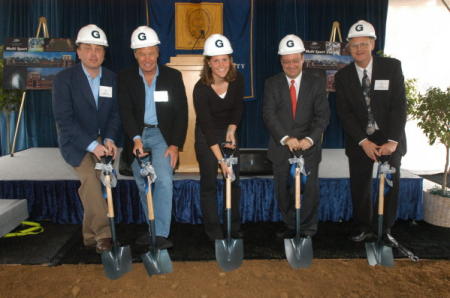
All eyes will be on campus Friday morning to the site of the former Georgetown tennis courts, where a ground breaking will take place for the John R. Thompson Intercollegiate Athletics Center. But if anyone suggests this is the first athletics ground breaking since McDonough Gymnasium, recall this photo:


That's a photo from the University's formal ground breaking of the Multi-Sport Facility, April 29, 2005. The photos were gone from this page at GUHoyas.com, but live on, thanks to Google.

The silence from Georgetown as to what has been done (or more, specifically, not done) about this project remains a puzzling legacy across two athletic directors and two interim ones. Unlike the Boathouse, there is no federal red tape to overcome, no community opposition, and no physical constraints that preclude its completion, or at least some spirited discussion. This is a set of permanent bleachers we're talking about, not Kyle Field, a $450 million stadium renovation in the middle of the Texas A&M campus. It's not even Tenney Stadium, a stadium at Marist College that cost just $4 million. In fact, Georgetown reported gifts of nearly $12 million to the MSF in 2005 but has said little about it since.

The last public comment on the MSF predates Lee Reed. On Sept. 10, 2009 (that's five years and two days ago), then-Vice President Dan Porterfield wrote:

"First, it is crucial that we complete the Multi-Sport Field, which hosts not only our football and lacrosse games, but also intramurals, club sports, and events such as the annual all-night Relay for Life, a major fundraiser for the American Cancer Society. The original design, which includes precast cement stands and a rebuilt foundation, has been an expensive proposition. Though improvements have been made to the field in the last few years, the project remains unfinished and still requires significant investment to complete. For that reason, I have asked colleagues in Athletics and the University to see if we can develop a cost-effective approach to completing the field. Our goals will stay the same: To improve our teams' game-day experience, to make the venue more fan-friendly, and to construct an aesthetically pleasing facility. As we develop new options for this important project in the coming months, we look forward to sharing its details with our friends and donors."

"The Field With No Name" has become a sad monument to Georgetown...from the temporary seats (that were being finished the morning of the home opener with Brown) that never went away, to the sand that piles up on its fringes from other construction projects more favorably blessed in the University's capital budget," wrote a blog post in 2010. "The message this project has sent to prospective students and prospective opponents is an exceedingly poor one--it's the academic equivalent of setting up trailers on Healy Lawn and telling people that this is the library."

"Few great universities would put up a temporary building, do nothing with it for five years and be satisfied with it. Georgetown would not have considered putting up temporary housing in the New South parking lot and calling it the Southwest Quadrangle. It would not have considered knocking out some drywall in the Ryan Administration building and hand it over to the fine arts department as its new facility. But five years later, where is the person that works outside McDonough Gym that sees this monument to institutional inertia and expects something better?

A week from now, Brown University returns to the field they inaugurated in 2005. Nothing has changed. It calls to mind a quote from University president Jack DeGioia: "The most distinctive thing about Georgetown is the fact that we are never satisfied. We are always seeking ways to be ever stronger, ever better, ever more true to our mission and identity."

It has been 3,281 days since construction was halted on the Multi-Sport Facility. There is no satisfaction in that number.

Monday, September 8, 2014

Week 2 Thoughts


Some thoughts following Georgetown's 23-14 loss to Dayton this past Saturday:

1. Footnote or Bellwether? Many who have followed Division I-AA football knew that Dayton's Connor Kacsor was a productive running back who can cause damage in the stat charts. Still, few would have predicted he would put up 300 yards on a Georgetown run defense that generally keeps big yardage efforts in check. What happened?

Kacsor was held in check in the first quarter, just 14 yards. But Dayton made no secret that  they would run Kacsor until Georgetown figured out a way to stop him, which it never did. Not only did Kacsor rush for 34 of the Flyers' forty carries, he rushed nine straight  plays to end the game and 17 of Dayton's final 20 plays--and still gained yardage!

There is a visible trend in Georgetown's  average yards allowed per rush. In the winless season of 2009, opponents averaged 4.7 yards per carry. By the 2011 season, that number had declined considerably, to just 2.9 yards. Since 2011, however, it has been on the rise: 3.8 yards in 2012, 4.4 in 2013. The current average of 5.3 after two games is inflated by Kacsor's numbers, but it bears watching. If Georgetown is allowing anything like it did in 2009 (and to some degree, 2013), it's in trouble, if for no other reason that it's allowing teams a much easier path to the end zone than via the pass.

Connor Kacsor is a fine runner but he's by no means the toughest running back on the 2014 schedule. If Georgetown can't regroup from what Kacsor did, watch out for Paul Stanton at Harvard.

2.  Week 3 Turnaround? Marist represents the most competitive game left on the 2014 schedule and the Red Foxes have struggled on offense, with just seven points in two games.

Marist's pass defense  is allowing 230 yards per game, nut more importantly, a 60 percent rate of completion by opposing quarterbacks. With two ineffective games from QB Kyle Nolan, the Red Foxes would seem a timely opportunity for the Hoyas to get back into an offensive rhythm.

Saturday's game may well be decided by time of possession. The Red Foxes were held to just 9:21 in the second half, and you can't win with numbers like that.

Then again, Georgetown managed just 10:31 versus Dayton in that same period.

3. C'mon, Really? From the A-10 network, this was the scoreboard appearance on the  A-10 Network feed through much of the first half:


Bulldogs?

Overall, the Dayton announcers were fairly objective, save when the Flyers scored, where its color analyst channeled an announcer at an SEC game. Upon the first Dayton touchdown, he exclaimed "Hot diggity dog!"

I'm guessing those are three words you won't hear from Chuck Timanus this season.

4. Schedule Talk: The Dayton announcers did not that the Flyers will not return the home game to Georgetown to Georgetown until the 2020 season, in that the  Hoyas did not have an open date that worked for each team until then.

That's good, I guess, but it raises the question--who's on those future schedules?

A peak at Ivy schedules suggests Georgetown is lining up a steady rotation of Harvard, Columbia, and Princeton later this decade, with a home game against Dartmouth (2015) in the mix. Add in six PL games and that still leaves two early September games each year. As to who they might be, I'm not sure. Wagner goes off the schedule this year, Davidson might be happier with an annual clobbering of College Of Faith, and while Marist is an easy add, is there someone else out there with a Georgetown on its future schedules?

5. 50th Anniversary Dinner. If you haven't heard about it, Georgetown is hosting a  gala dinner September 19 to honor 50 years of the modern era of the sport at Georgetown, and to honor the 1964 team that brought the game back to the Hilltop. If you're in the area next weekend, register now to attend.

Monday, September 1, 2014

Week 1 Thoughts

Some thoughts following Georgetown's 21-3 loss to Wagner Saturday:

1. The Lost Art: It was not unexpected that a 40-schoalrship Wagner team would have a string defensive effort against the Hoyas, but Georgetown's running game raises some serious questions about the viability of the offense this season.

In four previous games versus the Seahawks, Georgetown had rushed for 100 or more yards: 140 in 2010, 153 in 2011, 166 in 2012, 104 in 2013. It wasn't close Saturday, with 20 carries for just 19 yards. What happened?

The offensive line returns starters from 2013, the quarterback is the same as well. But a one running back set allows defenses to all but tee off on Joel Kimpela out of the backfield, and absent another back in the backfield, it's a pile-on.

Kimpela follows in a  decade-long run of the smaller running back at Georgetown, from Kim Sarin to Emir Davis,  Keion Wade and Mychal Harrison, Brandon Durham and Dalen Claytor.  Backs like Kimpela have been able to succeed, however, when there is help in the backfield, and in fact, larger backs like Charlie Houghton and Nick Campanella were, at times, able to take some of the pressure off the smaller backs as a result. For now, anyway, Kimpela seems to be the only option amidst just five backs on the roster, three with no prior experience, and opponents will use this to their advantage.

Which leads me to this lament: where is the fullback in modern college football? Is Georgetown that much better with four receivers instead of three?

2. The Opening Drive: Georgetown's talent level leaves it vulnerable on defense to opening game drives for touchdown, and such was the case Saturday. We discussed on this blog last year how the numbers were against Georgetown when they trailed early in games--the offense just isn't capable of quick strike drives unless Davidson is the opponent, which it isn't. (More on them later.)

Dayton enters this week's game with seven retuning starters on offense, including all three receivers. To avoid a similar outcome in Week two, the defense must make an early stand.

3. One Long Bus Ride: Georgetown makes its first ever visit to Dayton this week, a bus ride of eight hours, the longest such trip since the Hoyas visited Charleston Southern a decade or so ago.

Travel is nothing new to the Flyers, whose road games features bus and/or plane trips to  Duquesne (4 hrs), Davidson (8 hrs.) Marist (11 hrs.), San Diego (a flight of approx. four hours and roughly $75,000 in fares and lodging), and Butler (just 2 hrs.).

Georgetown's first visit to the Buckeye State was in 1936, a 7-0 win at Cincinnati's Nippert Stadium. its last was in 1976, a 30-3 loss at John Carroll University.

4. A Solid Effort: It's going to be difficult for the PL office to award a Player of the Week honor to a team like Georgetown who could be in trouble in every game from here on out, but Alec May put in a fine performance against Wagner and one of many to come.  Georgetown will have its struggles in 2014, but the defense will always come to fight.

5. Keeping The Faith?  Georgetown opened its season with Wagner in lieu of Davidson, which ended its series with Georgetown for, well,  um, eight losses in its last nine to the Hoyas. Coming off a 0-11 season, the Wildcats took a small step towards a softer schedule.

Make that a giant leap.

In lieu of games against Division II or Division III squads that were once common on the post-SoCon schedules for the Wildcats in the late 1980's and 1990's, Davidson opened its 2014 season with a 56-0 win over the College of Faith.

College of Faith does not belong to the NCAA or NAIA. In 1960's parlance, it would be considered a club team, except  that this club doesn't even have a campus , a classroom, or even a athletic facility. The team practices at a middle school.

"Charlotte’s College of Faith is an extension of the school’s main campus in West Memphis, Ark., along with other branches in Oklahoma and Florida," wrote the Charlotte Observer. "While its courses are online only, the Charlotte school is headquartered at the Cosmopolitan Community Church in West Charlotte, where the football team holds meetings and study hall."

"The Saints were 1-7 last season, their lone victory coming against North Georgia Sports Academy, a junior college. College of Faith struggled in other games, including losses against NCAA Division II teams Brevard (69-0) and Tusculum, Tenn. (63-0)."

The Wildcats led 43-0 at the half.

"[The] College of Faith football program is in its 2nd year of college football," one of its coaches posted on a recruiting web site. "We don't have S.A.T. or G.P.A. academic eligibility requirements. Our football program competes against NCAA D2, D3 and NAIA schools. We are looking for some impaact players of all sizes to help grow this great program into something special."

A win's a win, but it shouldn't be cannon fodder, either.

Tuesday, August 19, 2014

Five Questions, Defense

If there are questions with regards to a young Georgetown offense, the outlook for the Hoyas on defense is much more secure. A strong returning cast will continue a two decade strong tradition of defensive resilience, but will that be enough in an upgraded Patriot League? Here are five questions to consider:

1. Is This Jordan Richardson's Year? There is not a better candidate to rise to the top of the national defensive charts than Jordan Richardson, but now is the time.  He picked up only 20 solo tackles last season and while the nose guard position isn't a natural position for statistics, Richardson has the tools to be a much more impactful player on the line. Many opponents will look to run against the Hoyas and Richardson needs to take over that line.

2.  Who is Next In Line?: During Rob Sgarlata's run as defensive coordinator, there was a run of solid Hoya linebackers, most recently with Robert McCabe and Dustin Wharton.  Senior Nick Alfieri figures to continue this tradition, along side senior Patrick Boyle, who led the team in tackles last season. Together, they could form the best linebacker pair at Georgetown in the PL era, but the adjustments each must make within Coach Luke Thompson's defensive philosophy will be essential.

Overall, no position on the roster has the depth of linebacker for the Hoyas. As many as seven players could see time this year and despite the scholarship gap, Georgetown has continued to recruit well in this space.

3.  Can The Pass Defense Be Fixed?  Depth at linebacker is balanced by a secondary that has been picked apart in recent years. Georgetown allowed opponent quarterbacks to complete over 70 percent of its passes in PL play last season, and that won't cut it. The defense managed just three interceptions in PL play for a total of 14 yards.

The Hoyas averaged 262.7 yards per game in PL play, and with resurgent passing games at Fordham, Holy Cross, and Lafayette, that number could get worse before it gets better. It allowed 78 first downs by the pass last season, most among any PL team. A rough start in the opener versus Wagner and the road game at Dayton will be a bad omen for the team as a whole.

4. Can the Special Teams Respond? Georgetown rotates in a new punter and kicker this season, with sophomore Ben Priddy as the early leader for both. But of more concern is a special teams that allowed a league-high 33 net yards per kickoff return in the 2013 PL season with just one touchback. Giving opponents a short field on kickoffs is a recipe for problem against the kind of offense s Georgetown will face in 2014.

5. Who Manages Time Of Possession?  However much we would hope for the defense, the time of possession issue resides in the offense. When it's three and out, the defense bends and eventually breaks.  The time of possession fell from 28:57 in 2012 to 27:56 in 2013. Over the course of a season, that's literally 10  extra minutes for opposing offenses, and Georgetown can't stay ahead of that for long.

The number bottomed out at 25:46 in the winless 2009 season.  It won't drop below that in 2014, but if the offense does not develop a consistent running game, the defense may see another 10 minutes go on the season- long clock.

Next week: Five questions for the 2014 schedule.

Sunday, August 17, 2014

Five Questions: The Offense

Time moves quickly--ask the 19 Georgetown seniors who began their college football journey on the crest of an 8-3 team in 2011, only to win just six the next two years combined. Entering a season where the expectations for the 2014 Georgetown Hoyas are even more reduced in year two of the Patriot league's scholarship program, five questions for the Hoyas entering the 2014 season:

1. The Neuberger Way: After three years as an assistant at Columbia, Georgetown, and Cornell, respectively, Michael Neuberger has been promoted to offensive coordinator for a team which finished last in the PL for scoring and total offense.

There will be a period of adjustment from those players that followed the Vinny Marino offense, but Marino had a lot more tools to work with when he replaced Dave Patenaude than where Neuberger stands right now. The bulk of Georgetown's offensive throughout from 2013 graduated: Kempf, Campanella, Claytor, Durham,. Wilke, Sprotte...all gone.

By the second or third week, some new names figure to rise up the depth chart, particularly at receiver, where the need is especially great.

2. Breaking The Formula: With few exceptions (Nick Campanella, Charlie Houghton), Georgetown's backfield has been frequented by smaller, mobile, but ultimately injury prone backs. Does this change in 2014?

Over the last ten seasons, from Kim Sarin to Emir Davis, Chance Logan to Dalen Claytor, talented RB's have been worn down over the course of a season, leaving defenses to tee off on the Georgetown line because they know the Hoyas can't use the long ball.

In many case this is the byproduct of a lost art in college football: the fullback. Georgetown hasn't had an impact FB since Rob Belli, nearly 15 years ago.

If Trope Bullock can get some carries, it's going to take pressure off of Joel Kimpela, otherwise, the Hoyas are very thin at back, with only three tailbacks on the roster. And if 5-11, 195 lb. Kimpela can't hold up, how will 5-6, 160 lb. freshman Isaac Ellsworth fare?

3. QB Depth? In many of the lean years around Hoya football (read=since 2001), depth has been an issue at quarterback. Seven different quarterbacks have started in the past three seasons, and while Kyle Nolan is the clear #1 QB entering the pre-season, can he stand up fro 11 games? Tim Barnes has one game experience, sophomore Patrick Finnegan none, and freshman Peter Mahoney was out for his senior season at St. Ignatius HS with a leg injury.

Where have you gone, Stephen Skon? (Still on campus, just not playing football anymore.)

4. Whither The Wide Receiver? The Hoyas enter with some major questions in the receiver corps. Zack Wilke did his best last year but wasn't enough, leaving the rotation to junior Jake DeCicco, redshirt senior Michael Cimilluca, and any number of underclassmen.

The Hoyas averaged about 9.5 yards per completion last season but Georgetown has no deep threats, with only one pass last season of more than 29 yards.

5. Punting. Is this an question for the offense? Well, expect lots of punts to come Georgetown's way, and there is a need for someone to step up and provide the net yardage to keep the games from getting out of hand.

The Hoyas' punting game waned as the season went on, finishing sixth with a net of just 31.7 yards per kick. A solid kicking game is essential to controlling the field position game which has traditionally hurt Georgetown against deeper teams.

Next: Five questions for the defense.

Monday, August 11, 2014

Designing The Future(s) of Athletics At Georgetown

Part one of a continuing series.

Over the course of the last year, officials at Georgetown University have engaged in a series of lectures and exercises known as "Designing The Future(s) of the University". It's an interesting often provocative exercise that attempts to take on an industry to whom inertia is often a birthright (namely, academia) and ask the kind of questions businesses and non-profits ask regularly, namely, where do we want this place to be in 25 years?

Given the topic, and the participants, the discussions can be pedagogical and, well, a little dry.

"To encourage this type of coaching, universities need to create learning spaces that support meaningful student-faculty collaboration, including design labs and nuanced, interactive online platforms. Panelists identified the distinct value of the university in this new ecosystem of learning—its physicality, the availability of experts—which will be critical in defining the path ahead."

As I said, dry.

But many of these same questions, a little more adventurously, can be asked about athletics at Georgetown, or at any college or university. More so than any time in the past century, education is ripe for systemic change, perhaps unseen tioday, and with it, it may affect the way universities look at intercollegiate athletics as part of that environment. Add this uncertainty with the tremors facing the NCAA and how it manages a increasingly professionalized climate of competition, and you have the ingredients for a bumpy ride for college sports over the next quarter century.

Georgetown has never been an easy fit in college sports. It's a school that is best known for basketball, but it is not a basketball school. Its breadth of programs is more akin to the Ivy League than the Big 12, but produces more NBA talent than schools twice its size or its budget. And almost all of this has been built up over just 35 years--not by good fortune, by some shrewd planning that sought, and succeeded in doing what few schools outside of Stanford, Duke, and Notre Dame have done--build an national athletic brand without sacrificing its academic reputation.

Certainly, things can change suddenly. They have before.

Over nearly 150 years of athletics at Georgetown, four distinct periods of athletic upheaval took place, none by scandal but all by perception.

"On four separate occasions, 1894, 1905, 1932 and 1951 the leadership of Georgetown University, believing that it had become too important and too expensive, deemphasized Athletics by cutting University support," wrote sailing coach Michael Callahan in 2012. "If Georgetown Athletics costs increased by $9 million there is a strong risk that the debt incurred by Georgetown would lead many University leaders to believe that Athletics had once again become too important and too expensive."

In the two years since Callahan wrote these words as part of a master's degree thesis, the budget for Georgetown Athletics has increased by nearly $3 million.

One hundred years ago, 1914, Georgetown sponsored four men's sports for an undergraduate population of just over 200. Just five years removed from when the football and basketball programs were nearly shuttered and the crew team was set asunder, a different athletic model allowed a very small school to fight amongst the likes of Virginia, North Carolina, and Pittsburgh. While the College officially frowned on scholarships, the teams were increasingly run out of the graduate schools, particularly law, where older (and presumably, more experienced) men could play. The school did not fund the teams, but a "student manager" was given funding to hire coaches, set a schedule, and where he saw fit, to award scholarships. By 1916, Georgetown featured the leading rusher in college football, by 1918 the leading scorer in basketball. But times would change.

Seventy five years ago, 1939, Georgetown was back atop the national stage--not in basketball, but football. Its second unbeaten season in football saw it allow two touchdowns all season against the likes of Temple, Syracuse, West Virginia, and Maryland. Scholarships were not handed out as largesse, instead, the men on Georgetown's teams were expected to earn their keep with steady campus employment. An All-American might be counted upon to serve as a waiter in the campus dining hall, to fold laundry, or stack books in the library to earn his keep. But times would change.

Fifty years ago, 1964, Georgetown athletics was still under the cloud of the loss of intercollegiate football. Scholarships were less than half of what they were in 1950, and despite an increase in sports from eight to ten (and two women's sports in that mix), a growing list of club sports threatened to change the low-impact model devised in football's wake. Some club sports survived (football, lacrosse, rowing), others (polo, for example) did not. But times would change.

Over the next 25 years, athletics enjoyed a boom on the Hilltop--27 sports by 1989, a major expansion of women's sports, a move to Division I for all its teams, and an ability to leverage Georgetown's rising name recognition in basketball for financial gain, through royalty licensing, to help fund the growth. The athletic budget grew by nearly 10 fold from 1980 to 1990, and by the early 1990's, it was Georgetown -- Notre Dame or Texas or Florida State-- that accounted for more royalty sales from branded athletic apparel than any other university. But times would change.

In 2014, Georgetown Athletics remains a unique success story in spite of a number of instititutional, financial, and competitive roadblocks that would derail most schools. Despite a down period for many of its men's sports (including just one NCAA post-season win for men's basketball in six years), Georgetown remains among the most successful and emulated programs nationally. It does so, however, amidst the strains of a 29 sport program that has long outstripped its facilities, where the cost of education makes elevating some sports difficult if not untenable, and where the financial future of the program is intrinsically tied to a single television contract among a number of schools with a different academic and athletic profile than those it came of age with in the 1980's.

But Athletics isn't alone--it's Georgetown that is figuratively and literally bursting at the seams. It starts with cost.

By 1914, a "scholarship" to Georgetown was just over $400 a year, a reflection that most students of a certain age lived off-campus, that nearly all college classes were taught by Jesuits that did not take a salary, and with a campus of eight buildings across 104 acres, costs were manageable.

By 1939, a full year at Georgetown could cost up to $1,100 a year, but a steady job could cut that amount to a few hundred when all was said and done. By 1964, the campus population had doubled and tuition had nearly doubled as well. But both were nothing to what awaited their children's generations.

By 1989, a year of Georgetown, a year of study approached $20,000. Today. that's a bargain.

The entering classes at Georgetown will pay over $60,000 this year, and that's not even including the oft-discussed "cost of attendance" that has gripped the college sports world of late. At one time, the cost of attending college was less than half that of the median national income., today, its more than 120 percent of it.

If you are assuming costs will go down, you are either an optimist or one who believes the dollar will deflate into a pile of rubble. The Jesuit vows of poverty do not apply to lay faculty, the debt service on buildings continues unabated well into the 21st Century, and today's families increasingly value "new and improved" over "old and proven".

At a 3% growth rate (which isn't much, ask any faculty member), the cost of one year at Georgetown University will pass $75,000 by the end of this decade, and $100,000 by the end of the next. Assuming no spikes in inflation, no financial crises where Georgetown will have to sing for its supper, and no physical threat to the Nation's Capital that would otherwise imperil enrollment, the Class of 2039 will pay somewhere around $528,365 over four years of study.

How many parents are going to pay that for their son to play baseball? How many families are going to be able to afford a monthly payment of $11,007 for their daughter to play field hockey? How many basketball tickets will Georgetown have to sell to cover the rent at a aging, obsolete Verizon Center in 2039, assuming it hasn't been torn down by then?

The Athletic Department can't control the cost of inflation nor tis effects on the cost of education, a given. There was a time, back in the 1980's when I wrote for The HOYA, where the thought of $10,000 for year of education seemed unthinkable, and today, that wouldn't buy a year's room and board. But as Georgetown continues to strive to provide an outstanding curricular and extracurricular experience for its students, it's got to figure out how to afford to do it.

Much of it begins with the cost of scholarships. There's a reason why schools like Notre Dame and Louisville suddenly got good in a lot of sports--they invested in athletic scholarships to attract the best talent A full ride at South Bend is very attractive when the choice is a $30,000 loan to go to Georgetown. And that full ride will look better and better as the prices keep going up. If your son or daughter wants to play college sports, at what point is a Georgetown education unrealizable when competitive schools can turn that decision into a single digit, $0?

Schools like Texas and Ohio State, if they choose, could put nearly every athlete on full scholarship, a free ride. Stanford almost does now, Notre Dame is on that way. yet, at Georgetown, 21 of Georgetown's 29 sports account for less than 20 scholarships. Scholarships and coaching made Georgetown a basketball power in the 1970's, a lacrosse power in the 1990's and a soccer power in the 2000's. But if your kid plays football or baseball, wants to swim or row, or simply competes on his own in golf or tennis, is there any hope to get better?

"We do not believe that every team must compete for a national championship for that program to demonstrate competitive excellence, says Georgetown. "We acknowledge that Georgetown needs to invest further in athletics infrastructure in order to strengthen performance in some sports. But that need cannot be an excuse for any team’s failure to maximize the opportunity to compete with intensity."

Yet, according to Callahan, ” the level playing field is more of a dream than a reality. In the Big East Conference, the playing field is not level and the Conference Champion is more often than not the team that spends the most money. This poses a significant problem for many teams at Georgetown. When a student-athlete practices hard every day, sacrifices vacations, weekends, study time, and a social life to train hard, and the end result is four years of last place finishes, that student is often disillusioned. When student-athletes view their time spent in Georgetown Athletics as a negative, they are less likely to give back to the school. Georgetown Athletics fundraising figures show that teams who finish near the bottom of the conference simply do not raise as much money from their alumni as the teams who have won. Head coaches of teams that have no scholarship money often don’t solicit donations from alumni who were members of losing teams because they know they are not inclined to give back. This creates a vicious cycle of losing."

This is evident in football. When Georgetown joined the Patriot League , the understanding was that it could compete, even with a budget one half that of its competition, in a league which respected the nonscholarship philosophy Georgetown had built football up from after 1964. Three months after it finished 8-3, its best record in over a decade, the Patriot League voted to move to full scholarship football. With its first season competing against scholarships in the patriot League, the Hoyas dropped to 2-9. Within two years, six teams in the league will have 60, and one may have none.

"Georgetown Athletics has a math problem," said Callahan. "It is trying to fund 29 varsity sports on a budget that is too small to make every team a “Competitive” sport. It has made the decision to compete in the Big East Conference due to the value it brings primarily to the Men’s Basketball program and the revenue and exposure it brings to the University...[but] the current state of affairs within Georgetown Athletics and the Big East make it impossible for many of Georgetown’s sports to win. The competition is too strong. The difference in scholarships, facilities and recruiting is too much for most sports to overcome despite the cache of a Georgetown degree."

The answer to this dilemma is not to throw in the towel or to chuck 20 sports to prop up one or two, but to consider how this program can (and should) be positioned for success. Not for 2015, but for 2025 and 2035 as well. It's not just an issue in football but for every sport at Georgetown that is not getting a check from Fox Sports.

How does Georgetown, who clearly understands the importance of athletics in educating the "whole person", prepare for and execute a plan in a sports world that is more expensive, more expansive, and more explosive than we realize today? Today, it might be cost of attendance scholarships. Tomorrow it might be a player's union, or a basketball tournament only open to 60 or 70 schools. What then? More importantly, what now?

When Frank Rienzo, Joe Lang, and John Thompson built the foundation that has set Georgetown athletics on this most unlikely of journeys, it managed risk and uncertainty with innovation and strategic thinking. As they pass the torch to the next generation in McDonough Gymnasium, it's time to talk again, not only on where Hoya Athletics needs to be headed, but how it intends to get there.

In part 2, this question: is there a untapped funding model that can support a new generation of Georgetown athletics?

Tuesday, February 18, 2014

The Next Step Up

In his seminal 1947 book on the history of Georgetown football, author Morris Bealle tells the story of a coaching change that involved little fanfare nor newspaper glory. Far from the age of social media and breaking news, Rev. John Kehoe, S.J. walked up the hill from campus upon the practice field that would later bear his name. With a 5-9 former halfback in tow, Kehoe made his way to the field and walked onto the practice. An announcement was read to the team.

“Gentlemen, your new coach, Jack Hagerty.”

Eighty-two years later, Rob Sgarlata was introduced Tuesday as Georgetown’s head football coach without the fanfare common at many schools, yet, like Hagerty, he is someone to whom Georgetown football is more than a job, but a calling. Recruited by Scotty Glacken, studied under Bob Benson, and coached alongside Kevin Kelly, Sgarlata has been part of this program for 22 of the last 24 years. It’s a shared experience that figures to fortify the new coach against a daunting task that one of his predecessors faced so many years ago: putting the pride back into Georgetown football.

If there was a national search following Kevin Kelly's departure, it was a brief one. Sgarlata was the best choice given the circumstances of a position, and, let’s be frank, Pete Carroll wasn’t walking through that door. It's a door which opens to a program with a major college brand, a small college budget, and facilities best suited to a high school. A coaching search in early February was going to be daunting under any circumstances, much less one in which its predecessor struggled so visibly for not one or two years, but eight. Kevin Kelly saw his record drop from eight wins to two within two seasons as the shadow of scholarships began to dominate the entire Patriot League, that is, north of the Mason-Dixon line. It sent a subtle message that this may not be the job an aspiring coach is going to give two weeks notice for.

Doubtless there were candidates, but none with Sgarlata’s experience nor the perspective of what Georgetown football is and what it can become. The 5-8, 165 lb. Sgarlata wasn’t the biggest or fastest running back when he arrived from West Nyack, NY in the fall of 1990. By the time he graduated, Sgarlata would go on to lead the Hoyas in rushing two straight years, be elected team captain, and win the John L. Hagerty Award for the outstanding back on the team.

He has seen as much of the recent history of Hoyas as anyone, and at a front row to the action. He was there for the Bermuda Bowl, and the Yale Bowl. He was there to see the likes of Aley Demarest and Kyle Nolan, from Jim Bolger to Robert McCabe. He helped form a MAAC championship team in 1997, only to see an old teammate put up 69 on the Hoyas five years later.

Being somewhere is not a qualification to be a football coach, however. In his 18 years on the sideline and as the team’s chief recruiter in a job much more difficult than he will ever admit, Sgarlata coached the Georgetown defense in an era when defense was sometimes the only weapon the Hoyas had: Clarke, Fronczke, Buzbee, Ononibaku, Parrish, Schaetzke, McCabe, and Wharton were the names, but they all shared the same coaching leadership. In 13 years of Patriot League football at the Hilltop, Georgetown has produced only 13 first team selections. Twelve of the 13 were from the defense, and all 12 were coached by Rob Sgarlata.

(The earlier reference to Jack Hagerty has a historic parallel, however, and is not meant to compare Sgarlata in 2014 against the arguable candidate for Georgetown’s greatest ever football coach. But the uphill climb awaiting Sgarlata is not unlike what Hagerty faced when he succeeded Tommy Mills in 1932.)

Georgetown’s fall from an 8-2 team in 1928 to a 2-6-1 team by 1932 was not entirely a result on Mills, anymore than the last two years was the sole responsibility of Kevin Kelly. The decline of those Hoyas of an earlier era followed a quiet decision by University president W. Coleman Nevils S.J. to end athletic scholarships—Nevils felt Georgetown didn’t need scholarships to attract fine young men for sports like football. In theory, yes, in practice, not so much. It led Mills’ top assistant, Frank Leahy, to leave Georgetown after one season, saying that Georgetown exhibited “a certain coolness” to competitive football, and he wasn’t being complimentary.

With financial aid but little else, Hagerty’s first full season was a one-win campaign in 1933. Four win seasons followed in 1934 and 1935. By that time, Nevils had retired and his successor Arthur O’Leary, S.J. was amenable to some number of limited grants in aid. By 1936, Hagerty won six of nine games. By 1938, the Hoyas were undefeated. By 1940, the Hoyas were in the Top 10. All with just 20 scholarships, not the 80 or more common in the major college ranks of that era.

But it’s more than scholarships that turned Hagerty’s Georgetown program around in 1933. He understood the politics of the Healy Building, he knew when to push and when to pull, and he knew the importance in building internal support before he could demand external change.

Such is the challenge awaiting Sgarlata. There’s a light at the end of the tunnel for the Hoyas in the Patriot League; unfortunately, it’s a locomotive. Absent scholarships and with the highest bands in the PL’s Ivy Index, Georgetown could become severely non-competitive in a real hurry...say, this year. The last two recruiting classes are but a canary in that coal mine.

Georgetown football not only needs a coach, it needs an evangelist. Kevin Kelly understood this but always seemed uncomfortable doing so. A case must be made for not only what Georgetown football wants, but what it needs. It doesn’t have to be 60 scholarships or a 15,000 seat stadium. But it needs more than what it has right now, and a coach that can speak alongside a parent, a former player, or a University president and make that case, financial and otherwise, can begin to see results. The enduring promise is that no one sitting in McDonough or Healy that is “against” football, but they nonetheless expect football to create its own path to success. In this, the 50th anniversary of the season where students stepped up to bring back football to campus, 2014 can be a similar statement year about where this program needs to go.

It’s been done before. In 1993, a 28 year old coach named Bob Benson outlined seven steps to success when Sgarlata was a senior:

1. Establish accountability and discipline.
2. Emphasize the term student-athlete.
3. Reconnect with alumni.
4. Upgrading the schedule.
5. Recruit quality student-athletes.
6. Educate the leaders of the Georgetown University community about the game of football.
7. Win.

In 1999, he added four more:

8. Play peer institutions.
9. Build a new facility with all the tradition of the past in mind.
10. Place it in the center of campus.
11. Create a new school spirit among our students, faculty, and the community, and bring an environment with a wonderful aura of history and tradition to the Georgetown campus.

For better or worse, this is still the model of Georgetown football twenty years later, with success in some areas (“establish accountability and discipline”, “play peer institutions”), incomplete results in others (“win”) and abject failure in another (“build a new facility”). The challenge for Sgarlata is to revisit this model and kick the tires a bit.

The Benson mode took hold when there were as many as 30 I-AA non-scholarship football programs in the Northeast. Today, excepting the Ivies, there are only two: Georgetown and Marist. Will this model still work in 2015, in 2020, and beyond? If so, what does Georgetown need from its budget, from its alumni, and from its students to make it work? Is the Patriot League a safe harbor for a non-scholarship program like this or does Georgetown need a new course? Can Georgetown still build a program that will draw the next generation of scholar-athletes, or will it become a place for kids with a 1400 SAT that couldn’t get a free ride somewhere else?

“There must be a vision. It is really quite simple,” wrote Benson in 1999. “Utilize the game of football to create an environment and atmosphere among our students, faculty, and community on an autumn Saturday afternoon and bring to our campus a school spirit on a fall day that is desperately needed.”

Twenty years since he last wore #20, that vision now belongs to Rob Sgarlata. Among those who have preceded him, he stands in good company.